Card Up One’s Sleeve
The Definition
A common idiom meaning to have a secret plan, advantage, or resource kept in reserve to be used at a critical moment. It implies a hidden edge that your opponents are unaware of—a trick that can turn a losing hand into a sudden victory.
The Deep Dive
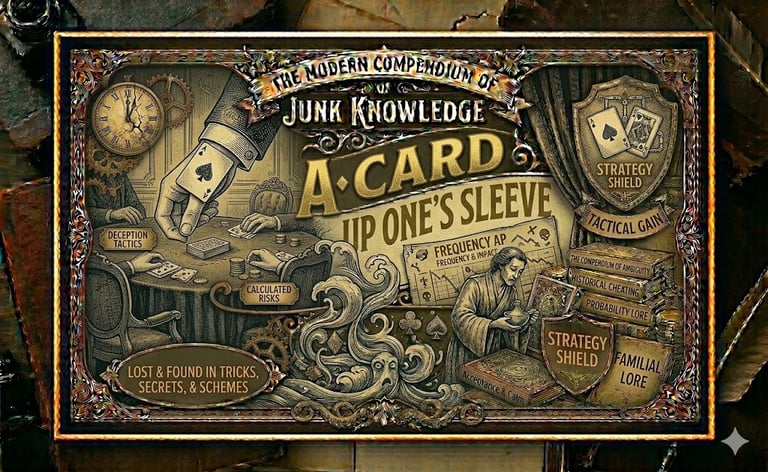
The "junk knowledge" behind "a card up one's sleeve" is that it isn't just a metaphor for cleverness; it was a mechanical reality of the 19th-century gambling world. Before it was a business cliché, it was a literal "tool of the trade" for card sharps and "mechanics" (cheats).
The Literal Concealment: In the mid-1800's, professional gamblers often wore stiff-cuffed shirts. A "holdout"—a mechanical device hidden up the sleeve—could be used to slide a high-value card (usually an Ace) into the gambler's hand or pull a "junk" card out of it.
The "Holdout" Device: These weren't just simple pockets. The most advanced "sleeve holdouts" were complex brass machines operated by a series of pulleys and strings attached to the gambler’s knees or torso. By expanding their chest or spreading their legs under the table, the cheat could trigger the device to "hand" them the winning card.
The "Short-Sleeve" Solution: This is why, in many high-stakes Western movies, you see players rolling up their sleeves before the deal. It was a physical way of proving they didn't have any mechanical "junk" hidden near their wrists.
The phrase reached peak "junk" status in the early 20th century, transitioning from the saloon to the boardroom. It represents preparedness: the belief that the person who wins isn't necessarily the one with the best luck, but the one who kept a secret "ace" for the final round.
Fast Facts
The "Ace in the Hole" Rival: While "up the sleeve" implies a trick, an "Ace in the hole" (from Stud Poker) is a legal hidden card that stays face down until the end. One is a cheat; the other is just a standard part of the game.
The Magician's Version: Stage magicians often use "palming" or "loading" techniques that are the professional descendants of the sleeve holdout. However, they call it "illusion," whereas a gambler calling it that would likely "get the axe" (or worse) from their "kith and kin" at the table.
The Modern "Sleeve": In digital projects, a "card up one's sleeve" might be a hidden line of code, a backup server, or an undisclosed feature that can be activated to save a failing launch.
References
Maskelyne, J. N. (1894). Sharps and Flats: A Complete Revelation of the Secrets of Cheating.
Ammer, C. (2013). The Dictionary of Clichés. Skyhorse Publishing.
The International Museum of the Horse & Gambling. (2026). The History of the Sleeve Holdout.