Cat Got Your Tongue
The Definition
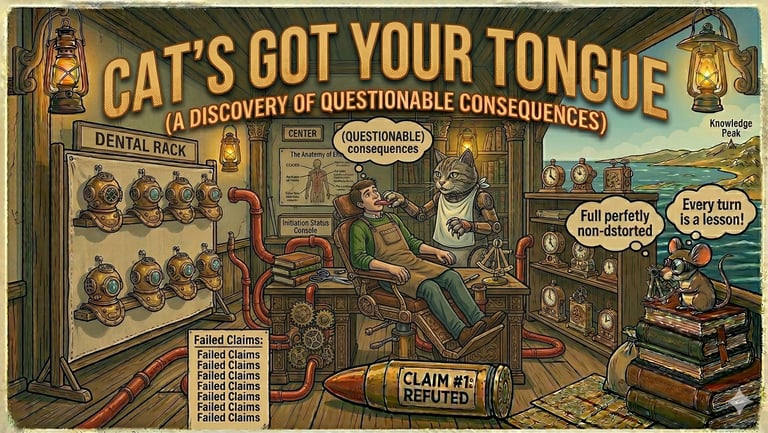
When a question is directed at someone who is unusually quiet, hesitant to speak, or at a loss for words it is said, "Cat got your tongue." It is often used to tease children or to challenge someone who is hiding a secret.
The Deep Dive
The origins of this phrase are shrouded in some of the grimmest "junk knowledge" in the English language. Unlike "Curiosity Killed the Cat," which deals with worry, this idiom is associated with physical punishment and ancient superstition. There are three primary theories:
The Royal Navy's "Cat": The most popular theory involves the "Cat-o’-nine-tails," a multi-lashed whip used for flogging sailors in the British Royal Navy. The pain of the lashing was so intense that the victim was often left speechless or unable to cry out. To ask if the "cat" had your tongue was a dark reference to being silenced by the whip.
The Egyptian Sacrifice: In Ancient Egypt, liars and blasphemers allegedly had their tongues cut out as punishment. These tongues were then fed to the cats of the temple (who were considered semi-divine). Thus, if you couldn't speak, it was because a cat literally had your tongue.
The Witch’s Familiar: During the Middle Ages, it was believed that if a person saw a witch or a "familiar" (often a black cat) performing a hex, the cat had the power to steal the witness's voice to prevent them from reporting the magic to the authorities.
Despite these colorful (and terrifying) theories, the phrase didn't actually appear in print until the mid-19th century in the United States. This suggests it may simply be a piece of lighthearted "nursery talk" designed to mimic the way a shy child might look—mouth open, but silent—as if an animal had made off with their ability to speak.
Fast Facts
The First Print: The phrase first appeared in Ballou’s Monthly Magazine in 1881, used in a context that was already treating it as a common childhood saying.
The "Nine Tails": The whip was called a "cat" because the scratches it left on a sailor's back resembled the scratches of a predatory feline.
Global Variations: Many cultures have "silence" idioms involving animals, but the cat is uniquely tied to the English version.
References
Ammer, C. (2013). The Dictionary of Clichés. Skyhorse Publishing.
Jeans, P. D. (2004). Ship to Shore: A Dictionary of Pictorial Maritime Grammar. McGraw-Hill.
Ballou’s Monthly Magazine. (1881). Volume 53. Thomes & Talbot.
Taggart, C. (2010). Her Who Must Be Obeyed: The Phrases and Sayings That Make Us Who We Are. Michael O'Mara Books.