Cat's Pajamas
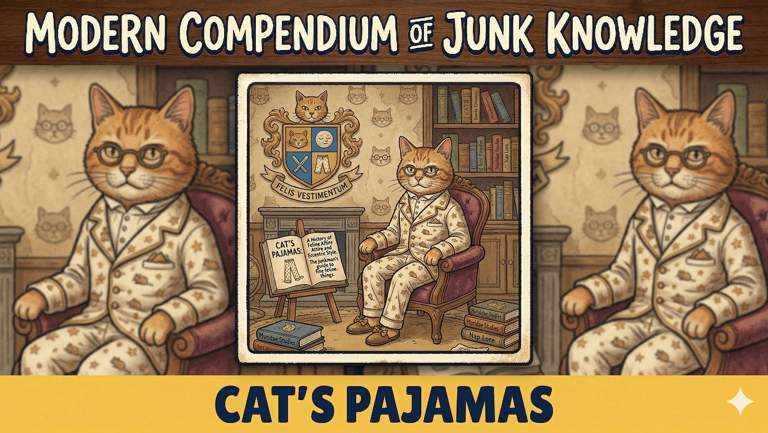
The Definition
A phrase used to describe something or someone that is superlative, stylish, or remarkably excellent. It is the 1920's equivalent of saying something is "the goat" or "cool," implying a level of peak performance and fashionable flair.
The Deep Dive
This is a classic piece of "junk knowledge" from the Flapper Era (c. 1920–1929). While the phrase sounds like nonsense, it was part of a specific linguistic trend among urban youths and "jazz babies" who delighted in pairing an animal with an unlikely piece of human clothing.
The Etiquette of the Absurd: In the 1920's, it was the height of wit to invent these combinations. If something was great, it wasn't just good—it was the Cat’s Whiskers, the Bee’s Knees, the Snake’s Hips, or the Monkey’s Eyebrows.
The "Pajama" Scandal: The choice of "pajamas" was particularly pointed. In the early 20th century, pajamas were a relatively new and daring fashion alternative to the traditional nightgown. For a woman to wear pajamas was seen as a sign of modern independence and "fast" living.
The "Cat" Factor: In Jazz Age slang, a "cat" was a term for a devotee of jazz music or a stylish, hip person. Therefore, providing a "cat" with the most modern, scandalous clothing imaginable—pajamas—was the ultimate metaphor for being "on the cutting edge."
The phrase is often attributed to the American cartoonist Tad Dorgan, who popularized much of the era's slang (including "hard-boiled" and "for crying out loud") in his widely syndicated comic strips. By the time the Great Depression hit in 1929, the whimsical animal-clothing metaphors began to fade, but the "Cat's Pajamas" survived as a permanent relic of the Roaring Twenties.
Fast Facts
The "Ewer" Theory: A common piece of "junk" etymology claims the phrase refers to an English tailor named E.B. Katz who allegedly made fine silk pajamas for royalty. However, there is no historical record of such a person, and the phrase is definitively American in origin.
The Bee’s Knees: While "Cat's Pajamas" is about style, the "Bee's Knees" likely referred to the fact that bees carry prized pollen in sacks on their legs—hence, the "best part."
The 1920's "Vibe": Other forgotten variations include the Elephant’s Instep, the Sardine’s Whiskers, and the Tiger’s Spots.
References
Dorgan, T. A. (Tad). (1920–1925). Indoor Sports (Syndicated comic strips).
Flexner, S. B. (1982). Listening to America. Simon & Schuster.
Ammer, C. (2013). The Dictionary of Clichés. Skyhorse Publishing.
The Oxford English Dictionary. (2026). Cat (n.1) and Pajamas (n.). Oxford University Press.