Caught Red Handed
The Definition
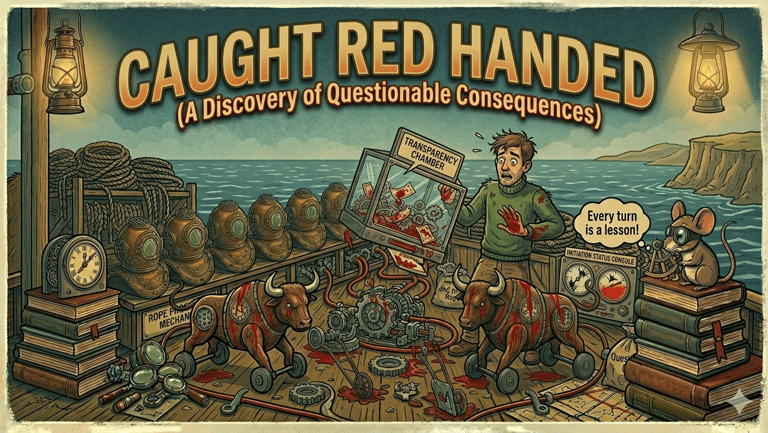
To be discovered in the act of committing a crime or a wrongful deed, with undeniable evidence of guilt present at the moment of apprehension. It describes the ultimate "no-exit" scenario for a culprit where their involvement is physically visible.
The Deep Dive
The "junk knowledge" surrounding this phrase is the common assumption that it refers generally to any messy crime. In reality, the term has a very specific, gruesome origin in 15th-century Scottish law, specifically concerning the illegal poaching and butchering of livestock.
Under ancient Scottish legal codes, it was difficult to convict a person of "gest-taking" (theft) unless they were found with the evidence. If a man was found standing over a slaughtered cow or deer with his hands literally stained by the blood of the animal, he was "caught red-hand."
The Blood Evidence: In an era before DNA testing or fingerprints, fresh blood was the most damning forensic evidence available. If the blood was still wet and red on the suspect's hands, it proved they were the one who had done the "bloody work" rather than someone who had simply stumbled upon a carcass.
The Legal Terminology: The phrase appeared in the Acts of Parliament of Scotland during the reign of James I. The law specified that a murderer or thief should be punished specifically if he was taken "red-hand"—meaning taken in the heat of the moment while the evidence of the deed was still fresh.
The phrase was popularized for a general audience by the legendary Scottish novelist Sir Walter Scott in his 1819 book Ivanhoe. Scott took the gritty, specific language of Scottish border law and transformed it into a dramatic literary idiom. By the mid-19th century, it had lost its literal connection to butchery and became a colorful way to describe any thief caught with their "hand in the cookie jar."
Fast Facts
The "Green" Variant: In some early forest laws, there was a related term called "Dog-draw," which referred to a poacher caught trailing a wounded deer. If they weren't "red-handed," they might be caught "dog-draw."
The First Print: While the concept is centuries old, the exact hyphenated version "red-handed" first appeared in Sir Walter Scott’s Guy Mannering (1815): "I was seven times apprehended... and once I was caught red-handed."
The Evolution: In modern corporate "junk" speak, the phrase has been softened. One can be "caught red-handed" in a lie or a data breach, even though there isn't a drop of blood (or even a physical hand) involved.
References
Scott, W. (1819). Ivanhoe.
Acts of the Parliaments of Scotland. (1432). Statutes of James I.
Ammer, C. (2013). The Dictionary of Clichés. Skyhorse Publishing.
The Oxford English Dictionary. (2026). Red-hand (adj.). Oxford University Press.