Chew the Fat
The Definition
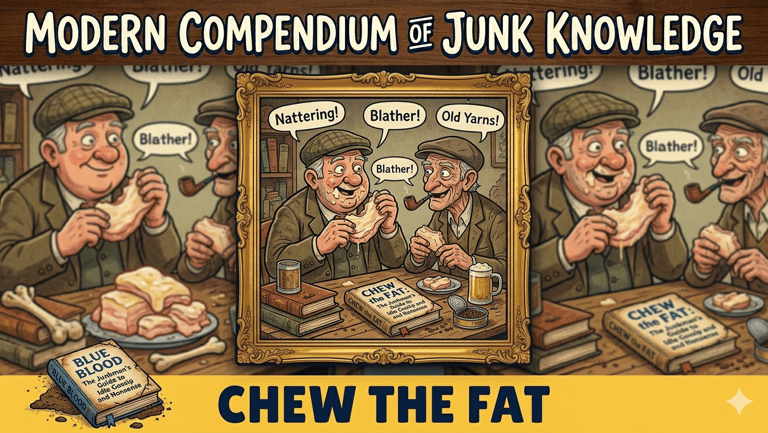
To chat idly, gossip, or engage in a long, leisurely conversation. It implies a relaxed, time-consuming social interaction where the talk is more important than the topic.
The Deep Dive
This phrase is a prime example of "junk knowledge" that bridges the gap between the high seas and the farm kitchen. While many assume it’s just a colorful way to describe the movement of the jaw during a long talk, the origin is rooted in the literal toughness of 19th-century rations.
Before refrigeration, sailors and soldiers were issued "salt pork" or "hard tack." These rations were preserved in brine and were often incredibly leathery.
The Sailor’s "Chew": On long voyages, when the work was light and the wind was steady, sailors would sit on the deck and gnaw on pieces of salt pork fat. Because the fat was so tough and salty, it took an immense amount of time to render it edible. This "chewing" became synonymous with the long, rambling stories (yarns) told to pass the hours.
The "Grisly" Gossip: In a domestic setting, "chewing the fat" referred to the scraps of a carcass left over after the choice cuts were eaten. To "chew the fat" was to sit by the fire and work through the leftover gristle—a slow, tedious task that naturally invited long-form conversation.
The phrase moved into the general lexicon in the late 1800's. It was popularized in the British military and eventually made its way into American English, where it shed its "fatty" literalism and became the standard term for a friendly, aimless "chinwag."
Fast Facts
The "Lard" Link: In some regions, the phrase was "chew the rag," which implied an even longer, more pointless conversation—as if you were chewing on something with no nutritional value at all.
First Recorded Use: One of the earliest appearances in print was in J. Brunlees Patterson’s Life in the Ranks (1885), describing British soldiers relaxing after a long march.
The Health Shift: Ironically, in the 20th century, "chewing the fat" became a health warning, but for the 19th-century sailor, the fat was the most prized, calorie-dense part of their meager diet.
References
Patterson, J. B. (1885). Life in the Ranks. (Early military usage).
Ammer, C. (2013). The Dictionary of Clichés. Skyhorse Publishing.
Jeans, P. D. (2004). Ship to Shore: A Dictionary of Pictorial Maritime Grammar. McGraw-Hill.
The Oxford English Dictionary. (2026). Chew (v.) and Fat (n.). Oxford University Press.