Chia Pets
The Definition
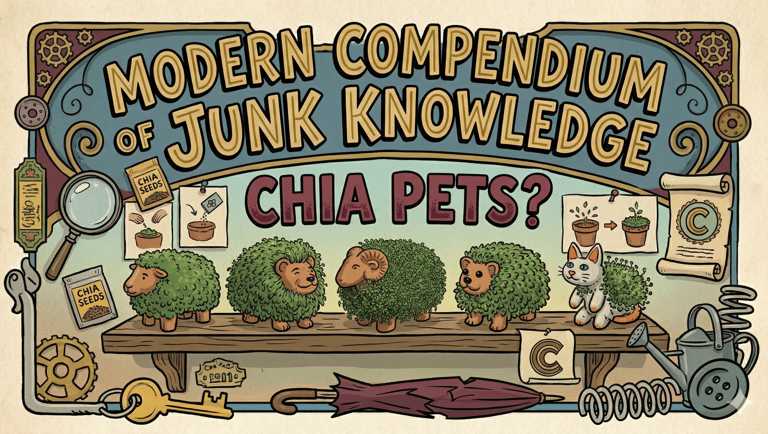
A series of American stylized terracotta figurines used to grow chia seeds, where the sprouted silk-like herbs mimic the hair or fur of the animal or character depicted. It is the quintessential "As Seen on TV" gift, representing the intersection of primitive pottery and kitschy 1980's marketing.
The Deep Dive
The "junk knowledge" surrounding the Chia Pet is the assumption that it was a purely modern invention of the 1970's. While the brand name is contemporary, the technology is ancient. The use of terracotta as a self-watering vessel for sprouting seeds dates back to the Aztecs, who valued Salvia hispanica (the chia plant) as a primary food source.
The Pottery Physics: Terracotta is naturally porous. When the hollow interior of a Chia Pet is filled with water, the moisture seeps through the clay walls to the exterior. The "junk" secret to a successful Chia Pet is the mucilaginous property of the seeds; when wet, chia seeds develop a sticky coating that allows them to adhere to the vertical, damp surface of the clay without falling off.
The Marketing Masterstroke: The modern Chia Pet was popularized by Joe Pedott, who bought the rights to the "Chia Ram" (the first model) in 1970. Pedott realized that the product wasn't just a plant—it was a performance. The famous "Ch-Ch-Ch-Chia!" jingle, which debuted in 1982, turned a slow biological process into a fast-paced cultural phenomenon.
By the 1990's, the "junk" status was cemented as the brand moved away from simple animals and into the realm of licensed celebrities and pop culture icons. The Chia Pet became the ultimate symbol of the "gift for the person who has everything," primarily because it was a gift that required work and provided a temporary, decorative result.
Fast Facts
The Superfood Twist: For decades, the seeds included with Chia Pets were viewed as "junk" or "craft" supplies. It wasn't until the 2010's that the mainstream health industry "rediscovered" chia seeds as a nutritional powerhouse rich in Omega-3 fatty acids.
The Smithsonian Induction: The Chia Pet is officially recognized as a piece of American history; several models, including the original Chia Ram, are held in the collections of the Smithsonian Institution.
The Space Growth: In 2002, chia seeds were sent to the International Space Station to study how plants sprout in microgravity, proving that the "pet" has scientific utility beyond the coffee table.
References
Pedott, J. (2012). The Story of the Chia Pet. (Corporate History).
Smithsonian Institution. (2024). National Museum of American History Collection: Chia Pets.
Ammer, C. (2013). The Dictionary of Clichés. Skyhorse Publishing.
Ayers, J. (2003). As Seen on TV: The Visual Culture of Everyday Lives in the 1950s. University of Chicago Press.