Chicken Feed
The Definition
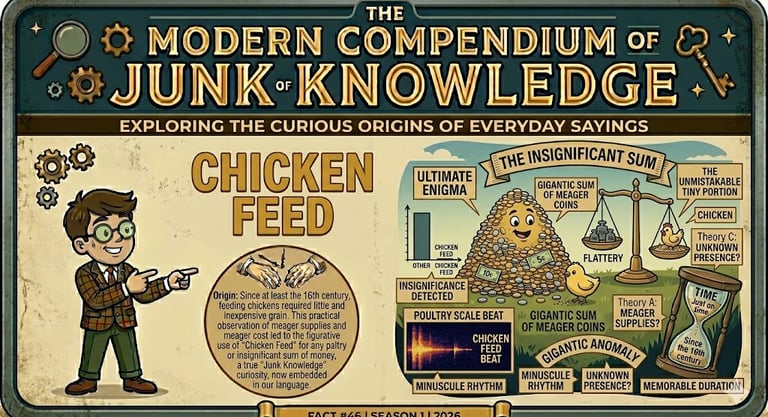
"Chicken feed" refers to a paltry or insignificant amount of money. Similar to [Chump Change], it describes a sum so small that it is barely worth mentioning, especially when compared to a much larger financial context. It is the "junk" change of the economic world.
The Deep Dive
The phrase is a literal agricultural observation that migrated into the world of high-stakes gambling and general commerce.
The Literal Standard: In the 19th century, chicken feed (the grain or "junk" scraps given to poultry) was incredibly cheap. Because chickens are small and unpicky, they could be sustained on the literal dust and leftovers from the more valuable grains used for horses and cattle. To pay someone in "chicken feed" meant you were giving them the absolute minimum required for basic survival.
The Gambling Pivot: The phrase gained its modern momentum in the early 20th century within the American gambling scene. It was used by high rollers to describe small bets or the meager winnings of casual players. If a poker pot wasn't worth the effort of a serious gambler, it was dismissed as mere chicken feed.
Secret Service Slang: During World War II and the Cold War, the term took on a more clandestine meaning. In the world of espionage, "chicken feed" refers to genuine but relatively unimportant information given to an enemy to gain their trust or to protect more sensitive secrets. By feeding the opposition "chicken feed," a double agent could maintain their cover without causing real damage to their own side.
Relativity in Finance: Like many terms in the Compendium, the value is relative. In a billion-dollar corporate merger, a million-dollar penalty might be described as "chicken feed"—a perspective that highlights the massive scale of modern economics.
Fast Facts
Early Records: The first recorded use of the term in a financial sense appears in American English around 1837, during a period of economic upheaval where small denominations of currency were often devalued.
Synonyms: Closely related to "small potatoes," "peanuts," and "song" (as in "bought for a song").
References
Ammer, C. (2013). The Dictionary of Clichés. Skyhorse Publishing.
Lighter, J. E. (1994). Historical Dictionary of American Slang.
Oxford English Dictionary. (2026). The Agricultural Origins of American Financial Idioms.