Chicken Out
The Definition
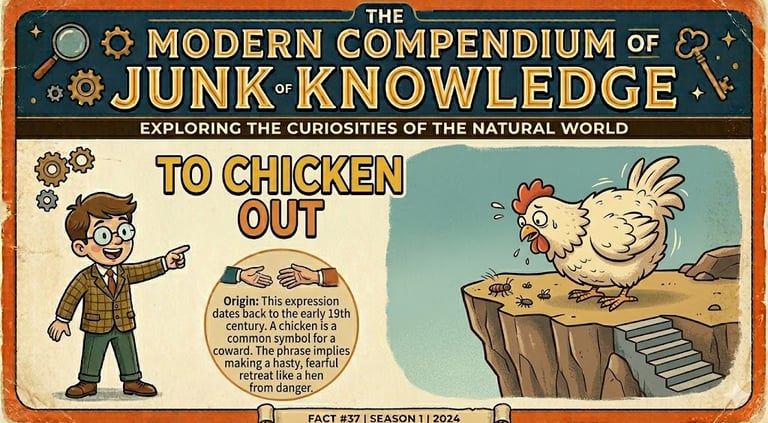
A common idiom meaning to withdraw from a commitment or a challenge due to a sudden loss of courage. It describes the moment fear overrides intent, causing someone to retreat from a situation they previously agreed to face.
The Deep Dive
The "junk knowledge" behind "chickening out" is that while we’ve used the word "chicken" to mean "coward" for centuries, the specific phrase "chicken out" is a relatively modern, mid-20th century American invention.
The Ancient "Chicken" Slang: Using "chicken" as a synonym for cowardice dates back to at least the 14th century. It likely stems from the flighty, easily startled nature of the bird. In The Catcher in the Rye (1951), Holden Caulfield famously uses the term, cementing its place in the postwar teenage lexicon as the ultimate insult to one's bravery.
The "Game of Chicken": The phrase "chicken out" evolved alongside the "Game of Chicken," a dangerous ritual popularized in 1950's youth culture (and movies like Rebel Without a Cause). In this "game," two drivers head toward each other on a collision course; the one who swerves first is the one who "chickened out."
The Biological "Freeze" vs. "Flight": To "chicken out" is a social description of the biological amygdala hijack. When the brain perceives a threat, it triggers a surge of adrenaline. If the "flight" response wins, the person retreats. Because a chicken's primary defense is to run away in a panicked, flapping frenzy, it became the perfect biological metaphor for a human who lacks "stomach" or "backbone."
The phrase reached peak "junk" status in the 1980's, famously utilized by the character Biff Tannen in the Back to the Future trilogy to goad Marty McFly ("What are you, chicken?"). It represents the "junk" of social pressure: the idea that the only thing more frightening than a dangerous task is the label of being "the one who swerved."
Fast Facts
The "Yellow" Connection: Being "chicken" is often paired with being "yellow-bellied." This likely refers to certain species of birds or lizards with yellow undersides, but in human terms, "yellow" has been a color associated with cowardice and treachery since the Middle Ages.
The Poultry Paradox: Despite their reputation, mother hens are notoriously fierce when protecting their chicks, often taking on predators much larger than themselves. To "chicken out" ignores the "mama bear" energy that actual chickens possess.
The "Cold Feet" Rival: While "chickening out" implies a sudden, panicked retreat, having "cold feet" suggests a slower, more contemplative dread that sets in as a big event (like a wedding) approaches.
References
Wilder, T. (1942). The Skin of Our Teeth. (Early usage of "chicken" as a verb).
Ammer, C. (2013). The Dictionary of Clichés. Skyhorse Publishing.
Salinger, J. D. (1951). The Catcher in the Rye. Little, Brown and Company.