Chink in the Armor
The Definition
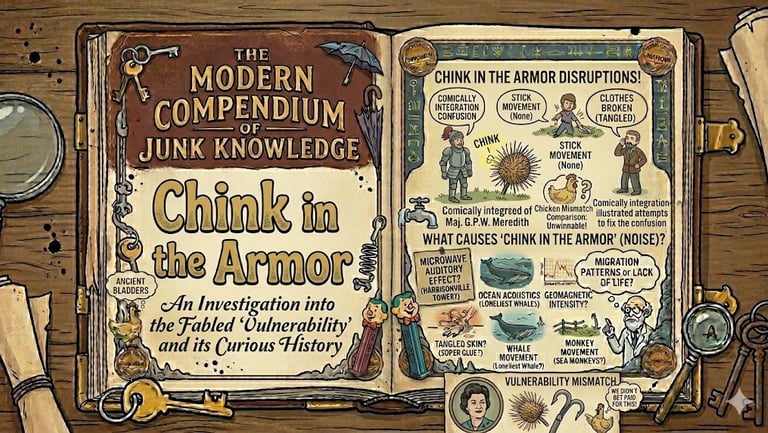
A minor but fatal weakness in an otherwise strong defense or an impeccable reputation. It refers to the specific point where an opponent can strike to cause the total collapse of a system, even if 99% of that system is impenetrable.
The Deep Dive
The "junk knowledge" behind this phrase is the literal engineering of 14th-century plate armor. As blacksmiths became more skilled, they created "harnesses" of steel that could deflect arrows, swords, and even early firearms. However, a human being still needs to breathe, move, and see, which requires joints and openings.
The "Chink" (Gaps): A "chink" originally referred to a narrow slit or crack (derived from the Middle English chine). In a suit of armor, these were the essential gaps at the armpits, the backs of the knees, and the vision slit of the helmet. No matter how thick the breastplate was, a well-aimed "mercy needle" (a thin dagger) could find the "chink" and end the fight instantly.
The Maille Backup: To mitigate the "chink," knights often wore a shirt of chainmail (hauberk) underneath the plate. This created a "layered defense," but even maille had its limits against a direct thrust to a joint.
The phrase transitioned from the battlefield to the literary world in the 17th century. It was popularized by writers like Thomas Fuller, who used it to describe flaws in a person's moral character. It represents the "junk" of perfectionism: the reality that the more "armored" and guarded we become, the more devastating a single, tiny oversight can be.
Fast Facts
The Linguistic Hazard: In modern times, the word "chink" has become a racial slur. Consequently, many journalists and public figures now avoid this idiom entirely, opting for "vulnerability" or "Achilles' heel" to avoid unintentional offense, despite the phrase's purely architectural origin.
The "Mercy" Dagger: The weapon specifically designed to find the "chinks" was the misericorde. Its name means "mercy," as it was used to provide a quick death to a fallen knight whose armor was otherwise too thick to pierce with a sword.
The "Aching" Armor: In the late 1800's, "chink" was also used to describe the sound of coins hitting each other. This led to a brief "junk" confusion where people thought the phrase referred to a wealthy person's "weakness" for spending money.
References
Fuller, T. (1642). The Holy State and the Profane State.
Ffoulkes, C. (1912). The Armourer and His Craft.
Ammer, C. (2013). The Dictionary of Clichés. Skyhorse Publishing.
The Oxford English Dictionary. (2026). Chink (n.). Oxford University Press.