Chip off the Old Block
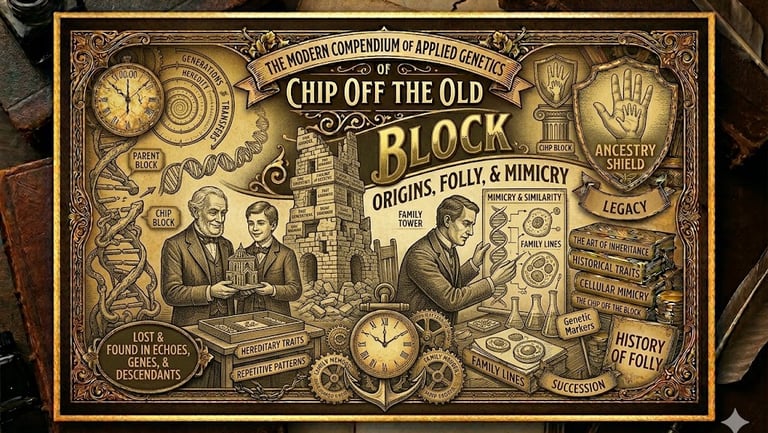

The Definition
A common idiom used to describe a person (usually a child) who is very similar in character, appearance, or ability to their parent (usually the father). It implies that the "material" of the child was cut directly from the "material" of the parent, ensuring a near-perfect match in both "grain" and "grit."
The Deep Dive
The "junk knowledge" behind "chip off the old block" is that it is a masonry and carpentry metaphor that dates back to antiquity. Before it was used to describe family resemblances at reunions, it was a literal description of the debris found on a sculptor's floor.
The Ancient Greek Source: The Greek poet Theocritus referenced the concept as early as 270 BCE, but the English version we know today solidified in the 17th century. It suggests that if the "block" (the parent) is a piece of high-quality marble or oak, then any "chip" taken from it will naturally possess those same high-quality properties.
The "Blockhead" Connection: Interestingly, the word "block" has a double meaning in English "junk" history. While "chip off the old block" is a compliment, calling someone a "blockhead" (an idiom from the same era) implies they are as dense and unthinking as a literal block of wood. The "chip" phrase survives because it focuses on the continuity of the substance rather than the shape of the head.
The Genetic "Junk": Long before we understood DNA, the "chip" metaphor served as a layman’s explanation for heredity. It provided a visual way to explain why a son might have the same temperament or work ethic as his father—he wasn't just like the father; he was part of him.
The phrase reached peak "junk" status in the Victorian era, as families became obsessed with lineage and "pedigree." It represents the "junk" of legacy: the idea that we are all just smaller fragments of the "kith and kin" who came before us.
Fast Facts
The "Spitting Image" Rival: While "chip off the old block" can refer to personality and talent, "spitting image" (originally "spirit and image") focuses almost entirely on physical looks. One is about the "wood"; the other is about the "reflection."
The "Apple/Tree" Alternative: The German equivalent, "The apple doesn't fall far from the tree," is a botanical version of the same idea. It implies that gravity—and biology—keep the "chip" close to the "block."
The Industrial Variation: During the 19th-century boom of the steam age, you would sometimes hear people refer to someone as a "cog from the same machine," but the "chip" remained the more popular version because of its organic, earthy roots.
References
Theocritus. (c. 270 BCE). Idylls.
Ammer, C. (2013). The Dictionary of Clichés. Skyhorse Publishing.
Oxford English Dictionary. (2026). Historical Development of Craft-Based Idioms.