Close, But No Cigar
The Definition
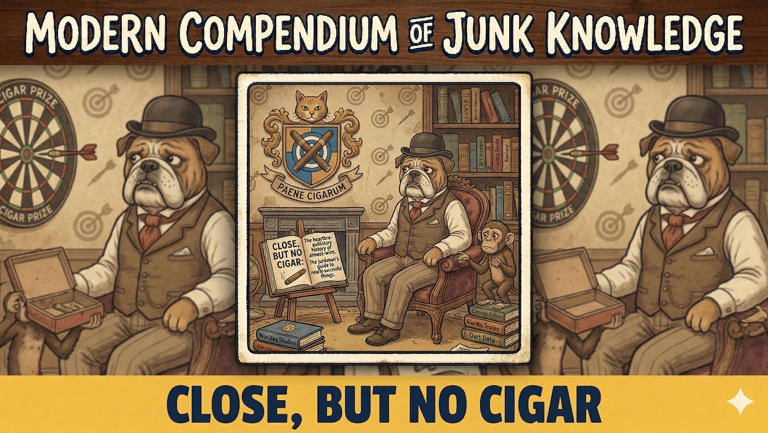
Used to describe an effort that was very nearly successful but ultimately fell short of the goal. It acknowledges a high level of performance while emphasizing that the final reward or "win" was not achieved.
The Deep Dive
This is a literal piece of "junk knowledge" from the traveling carnivals and fairgrounds of the late 19th and early 20th centuries. Before the era of plush over-sized teddy bears and cheap plastic toys, the standard "grand prize" for a man at a fair was a cigar.
Fairground games—like the "High Striker" (where you hit a lever with a mallet to ring a bell) or the shooting gallery—were marketed primarily to adult men.
The Tally: A high-quality cigar was a genuine luxury item in the 1880's. Winning one was a mark of strength or skill.
The Near Miss: If a contestant hit the lever hard enough to send the puck high but not high enough to strike the bell, the carnival barker would shout to the crowd, "Close, but no cigar!" to encourage the man to spend another nickel and try again.
The phrase moved from the midway to the mainstream in the 1920's and 30's. It was famously popularized in the 1935 film Annie Oakley, and later became a staple of American sports broadcasting and political commentary. By the time cigarette and cigar advertising was restricted in the mid-20th century, the "cigar" had already become a permanent metaphor for any elusive prize.
Fast Facts
The "Stogie" Reward: In many rural fairs, the prizes weren't just for games. Even local horse races or plowing contests would often award a box of cigars to the runner-up as a "consolation" prize—making the "no cigar" status even more frustrating.
The Film Boost: The phrase's popularity skyrocketed after it was used in the script for the 1947 film noir The Long Night, where it was used to describe a narrow escape from the police.
The "Good Cigar" Link: This is a linguistic cousin to the phrase "What this country needs is a good five-cent cigar," a famous 1917 quip by Vice President Thomas R. Marshall regarding the high cost of living.
References
Annie Oakley. (1935). RKO Radio Pictures. (Early cinematic usage).
Flexner, S. B. (1982). Listening to America. Simon & Schuster.
Ammer, C. (2013). The Dictionary of Clichés. Skyhorse Publishing.
The Oxford English Dictionary. (2026). Cigar (n.). Oxford University Press.