Close Shave
The Definition
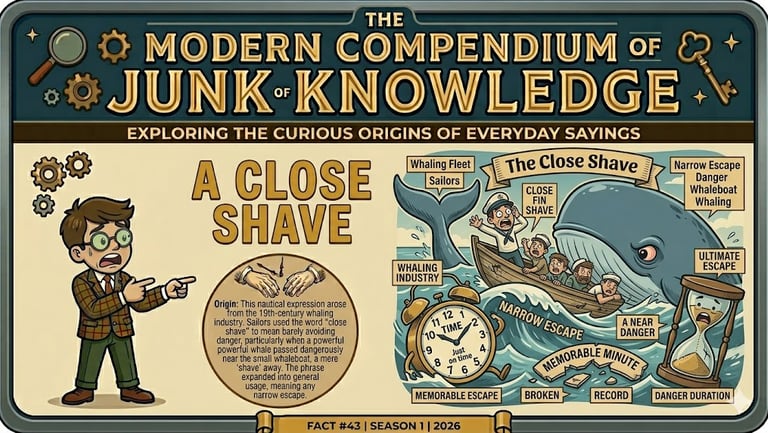
A narrow escape from danger, disaster, or a highly unpleasant situation. It describes a moment where the margin between safety and catastrophe was as thin as a single hair—a "skin of your teeth" encounter with the unexpected.
The Deep Dive
The "junk knowledge" behind "a close shave" is that it is a linguistic remnant of the era before safety razors, when getting groomed was a high-stakes gamble involving a straight razor and a very steady hand.
The Barber’s Blade: In the 18th and 19th centuries, men went to a barber for a "shave and a haircut." The tool used was an open, unprotected steel blade. A "close shave" was the mark of a master barber—one who could remove the hair so precisely that it left the skin perfectly smooth. However, if the barber’s hand slipped, or if the customer flinched, that "close shave" could quickly turn into a bloody disaster.
The Metaphorical Shift: By the mid-1800's, the phrase moved out of the barbershop and into the general lexicon. It became a way to describe any situation where you were "shaved" by danger but not "cut" by it. You felt the "blade" of the event pass by, but you emerged intact.
The "Narrow" Connection: It is a sibling to the phrase "a narrow squeak." Both imply that there was just enough room—a microscopic amount of space—for you to squeeze through the closing doors of fate.
The phrase reached peak "junk" status in the early 20th century, famously used in pulp novels and adventure serials. It represents the margins: the realization that our survival often depends on the few millimeters of space between us and the "axe."
Fast Facts
The "Clean Shave" Distinction: While a "close shave" is about danger, a "clean shave" is about aesthetics. One means you almost died; the other means you look presentable for your "kith and kin."
The "Close Call" Rival: In the United States, "close call" is often used interchangeably with "close shave." However, a "call" implies a judgment or a decision (like an umpire's "close call"), whereas a "shave" implies a physical, tactile brush with the edge of something sharp.
The Gillette Revolution: When King C. Gillette invented the safety razor in 1901, the literal risk of the "close shave" plummeted. We kept the idiom, but we lost the daily reminder of how dangerous a morning routine used to be.
References
Ammer, C. (2013). The Dictionary of Clichés. Skyhorse Publishing.
Gillette, K. C. (1904). U.S. Patent No. 775,134: Razor.
Oxford English Dictionary. (2026). Etymology of Shave and its Colloquialisms.