Cloud Nine
The Definition
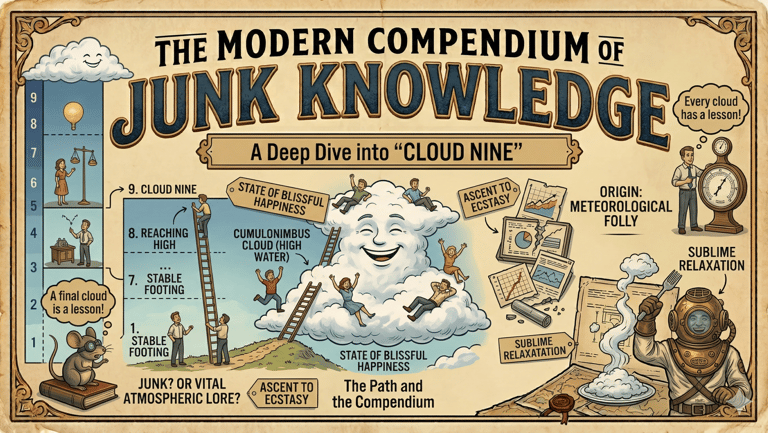
A state of extreme happiness, elation, or satisfaction. To be "on cloud nine" is to feel as though you are floating far above the mundane troubles of the earth, experiencing a rare peak of emotional well-on-top-of-the-world-ness.
The Deep Dive
While many assume this is just a random lucky number, the "junk knowledge" behind this phrase is a literal, scientific classification from the 1896 edition of the International Cloud Atlas.
In the early days of meteorology, the various types of clouds were categorized by their appearance and altitude, numbered one through ten.
The Altocumulus: In the 19th-century system, "Cloud Nine" was the designation for the Cumulonimbus—the massive, towering "anvil" clouds that can reach up to 40,000 feet or more.
The "Top of the World": Because Cloud Nine was the highest, fluffiest, and most majestic cloud in the sky, being "on" it meant you were at the literal highest point a human could imagine without leaving the atmosphere.
The "Ten" Paradox: You might wonder why we aren't on "Cloud Ten." In the original atlas, Cloud Ten was a much lower, less impressive cloud formation. Nine was the peak of the sky's architecture.
The phrase was popularized in the 1950's by the American radio drama Johnny Dollar, where the hero frequently found himself in states of "Cloud Nine" bliss. By the time George Harrison released his album Cloud Nine in 1987, the meteorological origins were largely forgotten, leaving behind only the feeling of high-altitude happiness.
Fast Facts
The Buddhist Link: A competing (though less documented) theory suggests the nine levels of "Cloud" refer to the stages of enlightenment in certain Buddhist traditions, where the ninth stage is a state of near-perfect bliss.
The "Seven" Shift: Before the 1950's, the phrase was often "Cloud Seven," likely influenced by the "Seventh Heaven" of Jewish and Islamic theology. "Nine" eventually won out, possibly because it sounded more substantial.
The Anvil Effect: The flat top of a Cloud Nine (Cumulonimbus) is caused by the cloud hitting the tropopause—the point where the air stops cooling with height—forcing the moisture to spread out horizontally.
References
International Meteorological Committee. (1896). International Cloud Atlas.
Ammer, C. (2013). The Dictionary of Clichés. Skyhorse Publishing.
Flexner, S. B. (1982). Listening to America. Simon & Schuster.
The Oxford English Dictionary. (2026). Cloud (n.) and Nine (n. and adj.). Oxford University Press.