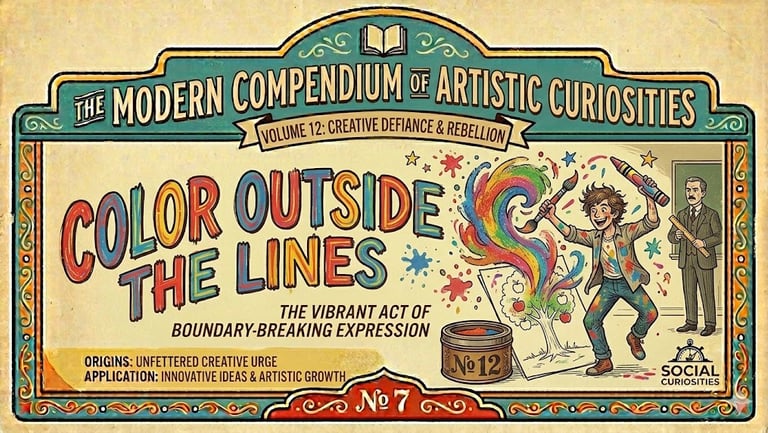
Color Outside the Lines
The Definition
A metaphorical idiom used to describe thinking creatively, breaking conventional rules, or approaching a problem in an unorthodox way. It suggests a refusal to be "boxed in" by the pre-existing boundaries (the "lines") of society, industry, or tradition.
The Deep Dive
The "junk knowledge" behind "color outside the lines" is that it is a 20th-century pedagogical metaphor. Before it was a boardroom buzzword for "disruption," it was a literal critique found on the report cards of kindergarteners.
The Coloring Book Constraint: The modern coloring book—with its bold, black outlines—became a staple of childhood education in the late 19th century. The goal for young children was to develop "fine motor skills" by keeping the wax crayon strictly within the printed boundaries. To "color outside the lines" was originally seen as a sign of physical imprecision or a failure to follow instructions.
The "Junk" Rebellion: In the 1950's and 60's, as psychology shifted toward valuing "individual expression," the phrase was flipped. Educators and artists began to argue that the "lines" were a form of "junk" conformity. Moving your crayon beyond the border wasn't a mistake; it was an act of artistic bravery—the first "step into the boots" of a creative rebel.
The "Brass Tacks" of Innovation: Today, the phrase is the calling card of the 800-pound gorillas of the tech world. They take a "tall order" and solve it by ignoring the "lines" of how things have always been done. The goal is to ignore the "flock" and find a brand-new idea.
The phrase reached peak "junk" status in the 1990's as a favorite cliché of motivational speakers. It represents the "junk" of non-conformity: the belief that the "best of both worlds" is only found by those willing to make a mess of the original drawing.
Fast Facts
The "Think Outside the Box" Rival: While "coloring outside the lines" is about artistic and rule-breaking spirit, "thinking outside the box" (derived from the Nine Dots Puzzle) is about lateral logic. One is about style; the other is about strategy.
The Precision Paradox: In your technical stock analysis, "coloring outside the lines" can be dangerous. If a stock’s price action breaks through a "support line," it’s not being creative—it’s a signal that the "home fires burning" are about to go out.
The Art World Reality: Many abstract expressionists, like Jackson Pollock, built their entire careers by refusing to acknowledge that the "lines" existed at all.
References
McLuhan, M. (1964). Understanding Media: The Extensions of Man. (Discussing the "lines" of literacy).
Ammer, C. (2013). The Dictionary of Clichés. Skyhorse Publishing.
Gardner, H. (1982). Art, Mind, and Brain: A Cognitive Approach to Creativity.