Cost an Arm and a Leg
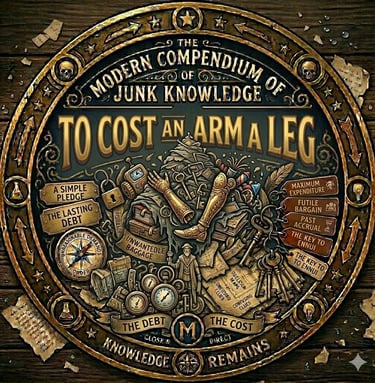
The Definition
To be exorbitantly expensive; to require a payment that feels like a literal sacrifice of one's own body parts. It describes an item or service whose price is so high it seems almost predatory or ruinous.
The Deep Dive
This is a "high-stakes" piece of junk knowledge that sits at the intersection of Fine Art history and Military medicine. While it sounds medieval, the phrase is surprisingly modern.
The Portrait Theory (The "Grand Pose"): A popular—though likely "junk"—legend from the 18th century suggests that portrait painters like Joshua Reynolds or Thomas Gainsborough charged based on how much of the body they had to paint.
A simple head-and-shoulders "bust" was the cheapest.
Including the arms (hands are notoriously difficult and time-consuming to paint) increased the price.
A full-length portrait, including the legs, was the most expensive of all. Therefore, a top-tier painting literally "cost an arm and a leg."
The Post-War Reality (The True Origin): Despite the charm of the painting theory, the phrase doesn't appear in print until the late 19th century, and it didn't become a common idiom until after World War I and World War II.
During these conflicts, thousands of soldiers returned home having lost limbs to artillery and landmines.
The "cost" of the war was measured in the literal arms and legs left on the battlefield. To buy something that was "worth an arm and a leg" was a somber reference to the ultimate price paid for freedom and survival.
The phrase reached peak popularity in the 1940's. It was first recorded in its modern form in a 1949 food advertisement, ironically used to describe the high price of meat—a "fleshy" pun that eventually lost its dark edge and became a standard way to complain about the price of a new car or a gallon of gas.
Fast Facts
The "French" Connection: The French have a similar idiom: Ça coûte les yeux de la tête ("It costs the eyes from your head"). This suggests that across cultures, humans naturally equate high prices with the loss of vital organs.
The "Half a Kingdom" Link: In fairy tales, the price is often "half the kingdom," but in the gritty reality of the 20th century, we traded land for limbs in our metaphors.
The First Print: The Long Beach Independent (California) used the phrase in 1949 to describe the high cost of living, cementing it as the go-to Americanism for "overpriced."
References
Ammer, C. (2013). The Dictionary of Clichés. Skyhorse Publishing.
Flexner, S. B. (1982). Listening to America. Simon & Schuster.
The Oxford English Dictionary. (2026). Arm (n.1). Oxford University Press.
Gainsborough, T. (1770). The Blue Boy. (Example of a 'full-cost' portrait).