Crocodile Tears
The Definition
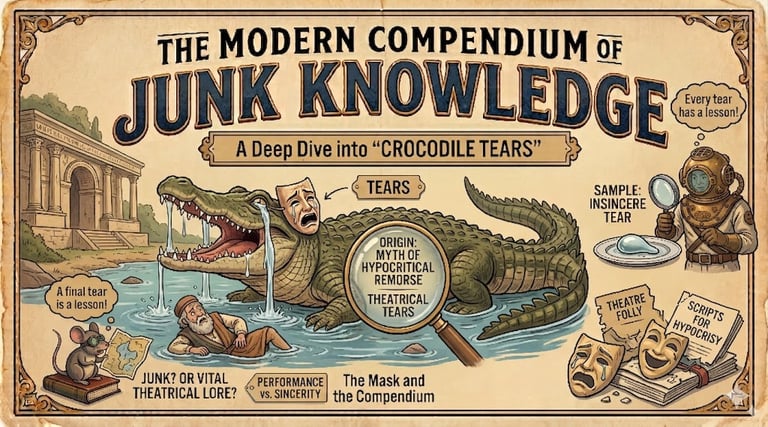
An insincere or hypocritical display of grief or remorse. It describes someone who sheds tears to gain sympathy or to manipulate a situation, while feeling absolutely no genuine sorrow.
The Deep Dive
This is a classic piece of "junk knowledge" that bridges the gap between ancient myth and modern biology. For centuries, it was a widely held "fact" that crocodiles were not only lethal predators but also master actors of the natural world.
The legend dates back to at least the 14th century, popularized by the travelogue The Voyage and Travels of Sir John Mandeville.
The Predatory Sob: According to the myth, crocodiles would sit on the banks of the Nile and weep loudly to mimic the sound of a person in distress. When a sympathetic traveler approached to help, the crocodile would snap them up.
The Post-Meal Moan: A variation of the legend claimed that crocodiles wept while eating their victims, seemingly overwhelmed by a sudden, paradoxical wave of guilt for their own nature.
The Biological Reality: In a rare twist, the "junk" has a grain of truth. Crocodiles actually do appear to weep. They possess lachrymal glands that produce fluid to lubricate their eyes, especially when they have been out of the water for a long time.
Furthermore, when a crocodile eats, it huffs and hisses as it gulps down air. This air pressure can force the fluid out of the tear ducts, making it look as though the reptile is sobbing over its lunch. The "remorse" is entirely mechanical, but the visual was so striking to ancient observers that it became the ultimate symbol of the "fake cry."
Fast Facts
The Shakespearean Boost: Like many idioms, Shakespeare helped cement it in English. In Othello, the Moor cries: "If that the earth could teem with woman's tears, / Each drop she falls would prove a crocodile."
The Mandeville Source: Sir John Mandeville's 14th-century book was a bestseller of its time, filled with fantastical claims about "men with heads of dogs" and, of course, weeping crocodiles.
Crocodile Tears Syndrome: In medicine, "Bogorad's syndrome" is a rare condition where a patient sheds tears while eating (often following facial nerve paralysis), colloquially known as "Crocodile Tears Syndrome."
References
Mandeville, J. (c. 1357). The Voyage and Travels of Sir John Mandeville.
Shakespeare, W. (1603). Othello. (Act IV, Scene 1).
Vliet, K. A. (2007). An Observation of Crocodile Tears. (BioScience study on reptilian lachrymation).
The Oxford English Dictionary. (2026). Crocodile (n.). Oxford University Press.