Cry Over Spilled Milk
The Definition
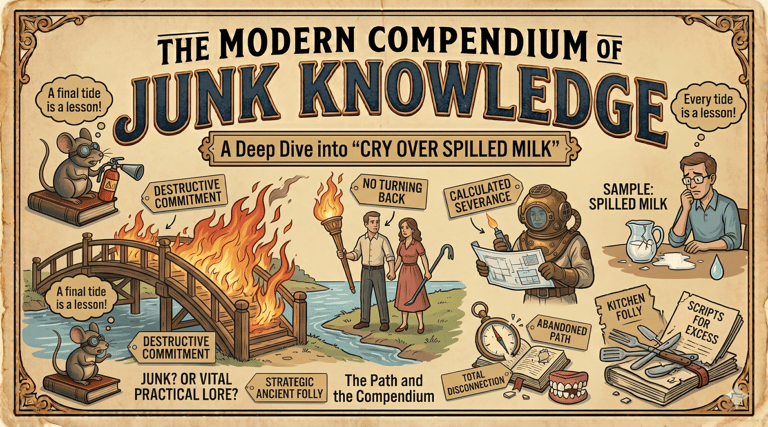
To waste time being upset about a past mistake or an unfortunate accident that cannot be undone. It is the ultimate "junk" idiom for moving on, suggesting that the energy spent grieving a minor loss is more wasteful than the loss itself.
The Deep Dive
This is a "high-calcium" piece of junk knowledge that bridges the gap between 17th-century British proverbs and ancient European folklore. While we now use it to brush off a minor fender-bender or a lost set of keys, the "milk" in question was once seen as a spiritual sacrifice.
The Fairy Offering: In Old English and Celtic folklore, it was common practice to leave a small bowl of milk outside for the "Fairies" or "Brownies" (household spirits). If a bowl was accidentally knocked over, it wasn't seen as a tragedy—it was simply believed that the spirits had "taken" their share. Therefore, crying was useless because the milk had already served its supernatural purpose.
The "Penny" Value: In a pre-industrial village, milk was a staple but not a luxury. Unlike an ox dying or a barn burning down, a spilled pail of milk was a "low-stakes" disaster. It was messy and annoying, but it didn't threaten the survival of the family.
The Irreversibility: Once milk hits a dirt floor or a wooden plank, it is physically impossible to reclaim. Unlike a dropped coin or a misplaced tool, "liquid" mistakes are final. The "junk" wisdom here is purely mathematical:
Loss A: The milk.
Loss B: The time and emotional energy spent crying.
The Result: Loss B is always greater than Loss A because you still don't have the milk, and now you’ve lost your afternoon.
The phrase was first recorded in its near-modern form by the British writer James Howell in 1659, who wrote: "No weeping for shed milk." It remains the gold standard for "practical stoicism" in the English language.
Fast Facts
The "Water" Alternative: In some early variations, the phrase was "crying over spilled water," but milk replaced it because milk has more "value" and is more visible (and harder to clean) when spilled.
The "Shed" vs. "Spilled" Shift: In the 17th century, the word "shed" was more common than "spilled." Over time, "shed" became associated primarily with blood or tears, leaving "spilled" for the kitchen.
The First Print: James Howell’s Paramoigraphia (1659) is the first documented collection to include the proverb as a piece of "folk wisdom."
References
Howell, J. (1659). Paramoigraphia: Proverbs, or Old Sayed Sawes and Adages.
Ammer, C. (2013). The Dictionary of Clichés. Skyhorse Publishing.
The Oxford English Dictionary. (2026). Milk (n.1). Oxford University Press.
Briggs, K. M. (1976). An Encyclopedia of Fairies. (On the 'milk offerings' to household spirits).