Curiosity Killed the Cat
The Definition
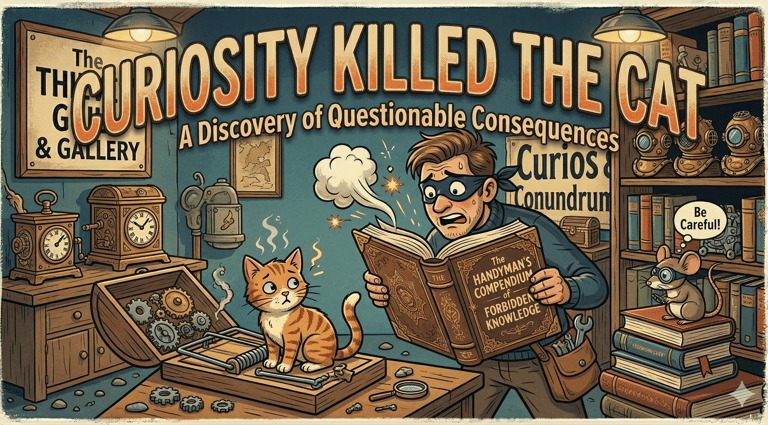
A common warning used to stop someone from prying into affairs that do not concern them. It implies that being too inquisitive can lead to dangerous or unpleasant situations.
The Deep Dive
Contrary to popular belief, the cat wasn’t originally killed by "curiosity." In the earliest iterations of the phrase, the culprit was actually care.
The phrase first appeared in Ben Jonson’s 1598 play Every Man in His Humour, later performed by a troupe including William Shakespeare. The original line was: "Care killed a cat." At the time, "care" didn't mean "looking after someone"; it meant worry or sorrow. The idea was that even a creature as resilient as a cat—supposedly blessed with nine lives—could be stressed to death.
The transition from "care" to "curiosity" didn't gain traction until the mid-1800's. It was first printed in its modern form in The Galveston Daily News in 1898 and later solidified in Eugene O'Neill's 1920 play Diff'rent.
The "Satisfaction" Clause: Many people attempt to soften the blow by adding, "But satisfaction brought it back." While a comforting sentiment, this was a much later addition (first recorded in the early 20th century) likely created by people who felt the original proverb was a bit too grim for children.
Fast Facts
The Original Culprit: Worry (Care).
First Known Appearance: 1598 (Jonson).
The Survival Rate: Statistically, cats are actually quite good at surviving curiosity; they possess a "righting reflex" and highly developed peripheral vision.
Scientific Counterpart: In physics, "Schrödinger's Cat" exists in a state of being both dead and alive until someone looks—making the act of curiosity the literal catalyst for the cat's fate.
References
Ammer, C. (1997). The American Heritage Dictionary of Idioms. Houghton Mifflin.
Jonson, B. (1598). Every Man in His Humour. (Act I, Scene 3).
Taggart, C. (2010). Her Who Must Be Obeyed: The Phrases and Sayings That Make Us Who We Are. Michael O'Mara Books.
The Galveston Daily News. (1898, August 10). "Curiosity killed the cat, but satisfaction brought it back."