Dancing Plague of 1518
The Definition
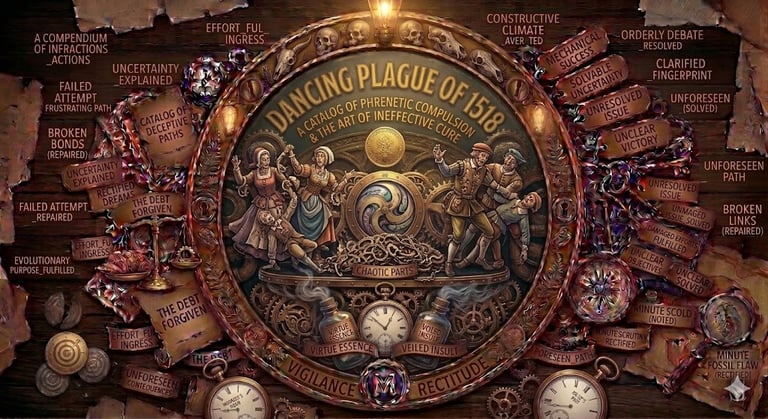
The Dancing Plague was a case of social phenomenon or mass psychogenic illness that occurred in Strasbourg, Alsace (then part of the Holy Roman Empire). It involved hundreds of people dancing uncontrollably for weeks on end, leading to exhaustion, injury, and in some cases, death. It remains one of history’s most bizarre and debated instances of collective behavior.
The Deep Dive
This was not a celebratory festival gone wrong, but a localized disaster that the authorities of the time were completely ill-equipped to handle.
Patient Zero: The plague began in July 1518 when a woman named Frau Troffea stepped into a narrow street and began to dance fervently. She didn't stop for nearly a week. Within a month, about 400 people—mostly women—had joined her in the rhythmic, involuntary movement.
The Medical "Junk" Advice: At a loss, the city’s physicians and authorities rejected the idea of a religious curse. Instead, they diagnosed the dancers with "hot blood." Their solution was to encourage more dancing to "burn the fever out." They constructed a wooden stage, hired musicians, and even brought in professional "strongmen" to keep the afflicted upright and moving. This only exacerbated the problem, as more onlookers were seemingly "infected" by the sight.
The Toll: Contemporary chronicles claim that at its height, the plague was killing up to fifteen people a day through strokes, heart attacks, and sheer physical exhaustion. The dancers were reportedly screaming in pain or pleading for help even as their feet continued to move.
The Resolution: Eventually, the authorities realized the musical intervention was a failure. They banned dancing in the city and moved the afflicted to a mountain shrine dedicated to St. Vitus, the patron saint of dancers and epileptics. There, they were given red shoes and led in religious ceremonies until the "fever" finally broke.
Theories of Origin
Ergot Poisoning: One popular theory suggests the dancers had consumed rye bread contaminated with ergot, a fungus that contains psychoactive alkaloids (similar to LSD). While ergotism can cause convulsions and hallucinations, critics argue it would be physically impossible for someone to dance for days on ergot; they would more likely be incapacitated.
Mass Psychogenic Illness: Modern historians, such as John Waller, argue the plague was a psychological response to extreme stress. In 1518, Strasbourg was suffering from famine, smallpox, and syphilis. The belief in St. Vitus's power to curse people with a dancing plague may have triggered a trance-like state in a population pushed to the brink.
Fast Facts
The St. Vitus Connection: For centuries afterward, the neurological disorder Sydenham's chorea was commonly known as "St. Vitus's Dance" due to the jerky, involuntary movements of the limbs.
Not a One-Off: While 1518 is the most famous, there were dozens of recorded dancing manias across Europe between the 10th and 17th centuries.
References
Waller, J. (2008). A Time to Dance, a Time to Die: The Extraordinary Story of the Dancing Plague of 1518.
Backman, E. L. (1952). Religious Dances in the Christian Church and in Popular Medicine.
Oxford English Dictionary. (2026). Historical Etymology of 'Chorea' and Social Manias.