Dead as a Dodo
The Definition
Unequivocally finished, obsolete, or beyond any hope of revival. It describes something that is not just "gone," but has been completely erased from the functional world, often due to an inability to adapt to new circumstances.
The Deep Dive
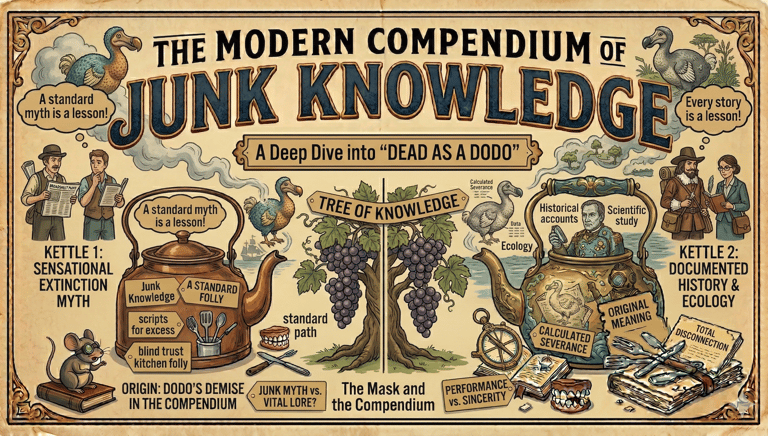
This is a literal piece of "junk knowledge" from the tragic history of the island of Mauritius in the Indian Ocean. The Dodo (Raphus cucullatus) was a flightless bird that lived in a predator-free paradise for millions of years. Because it had no natural enemies, it lost the ability to fly, grew to a bulky 20 kilograms, and developed a famously "fearless" (or, to humans, "stupid") disposition.
The Arrival: When Dutch sailors arrived in 1598, they found a bird that didn't run away when approached. The sailors called it walghvogel (disgusting bird) because its meat was tough and greasy, but they killed them anyway for sport and provisions.
The "Junk" Cause: The Dodo didn't just die out because of hunting. The "junk" reality is that the sailors brought pigs, rats, and monkeys on their ships. These invasive species ate the Dodo eggs, which were laid in vulnerable nests directly on the ground.
The Record Speed: The Dodo went from "discovered" to "extinct" in less than 100 years. The last confirmed sighting was in 1662. Because it happened so quickly and on such a remote island, many 18th-century scientists actually believed the Dodo was a myth—a "junk" invention of bored sailors—until physical remains were finally analyzed in the mid-1800's.
The phrase "dead as a dodo" didn't enter the common English lexicon until the late 19th century, following the publication of Lewis Carroll's Alice's Adventures in Wonderland (1865), which featured a Dodo character. The bird became the universal poster child for the finality of extinction.
Fast Facts
The Name: "Dodo" likely comes from the Portuguese word doudo, meaning "fool" or "crazy," referring to the bird's lack of fear toward humans.
The Pigeon Cousin: DNA analysis has proven that the Dodo's closest living relative is the Nicobar pigeon, a colorful flying bird found in Southeast Asia.
The "Mummy" Mystery: For centuries, the only complete stuffed Dodo was in the Oxford University Museum, but it became so moth-eaten and rotten that the curators burned most of it in 1755, leaving only a head and a foot behind.
References
Carroll, L. (1865). Alice's Adventures in Wonderland. (Macmillan).
Quammen, D. (1996). The Song of the Dodo: Island Biogeography in an Age of Extinctions. Scribner.
Strickland, H. E., & Melville, A. G. (1848). The Dodo and Its Kindred. Reeve, Benham, and Reeve.
The Oxford English Dictionary. (2026). Dodo (n.). Oxford University Press.