Dead Ringer
The Definition
A person or thing that is an exact duplicate or look-alike of another. It describes a resemblance so perfect that it could lead to a case of mistaken identity.
The Deep Dive
This is a "high-octane" piece of junk knowledge that pits a terrifying urban legend against the gritty reality of the 19th-century horse track.
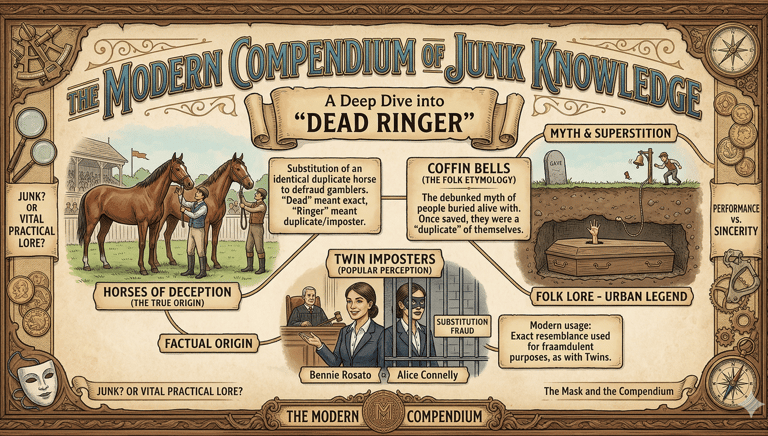
The Safety Coffin (The "Junk" Legend): The most popular—and likely fabricated—origin story centers on the Victorian fear of being buried alive (taphophobia). According to the legend, "safety coffins" were equipped with a string tied to the deceased's hand, leading to a bell above ground. If the "corpse" woke up, they would pull the string, and the watchman would hear a "dead ringer" and dig them up. While these coffins actually existed (patented by inventors like Count Karnice-Karnicki), there is zero historical evidence of anyone ever being saved by one, nor of the phrase being used in this context.
The Racetrack "Ringer" (The Reality): The true origin is found in the world of horse racing in the late 1800's. A "ringer" was a fast, high-quality horse that was illicitly substituted for a slower, mediocre one to manipulate the betting odds. To make the deception work, the "ringer" had to be a perfect physical match for the slower horse—a "dead" match (where "dead" means "exact" or "absolute," as in "dead center").
The term "dead ringer" first appeared in print in the US in 1888, used specifically to describe these equine impostors. By the early 20th century, the phrase had jumped the fence from the racetrack to describe any person who looked remarkably like someone else.
Fast Facts
The "Dead" Adverb: Using "dead" to mean "completely" or "unerringly" is an old linguistic trick, also seen in phrases like dead certain, dead tired, and dead reckoning.
The Karnice-Karnicki Coffin: The most famous safety coffin, patented in 1897, included a tube for air and a mechanical signal, but it was so expensive and impractical that it never caught on.
The "Graveyard Shift": Another piece of associated junk knowledge claims the "graveyard shift" was the watchman waiting for the bells to ring. In reality, it was just a 19th-century term for the quiet, eerie midnight-to-dawn work shift.
References
The Sun (New York). (1888, June). Sporting News: The Ringer at the Track.
Bondeson, J. (2001). Buried Alive: The Terrifying History of Our Most Primal Fear. W.W. Norton & Co.
Ammer, C. (2013). The Dictionary of Clichés. Skyhorse Publishing.
The Oxford English Dictionary. (2026). Ringer (n.1) and Dead (adv.). Oxford University Press.