Different Kettle of Fish
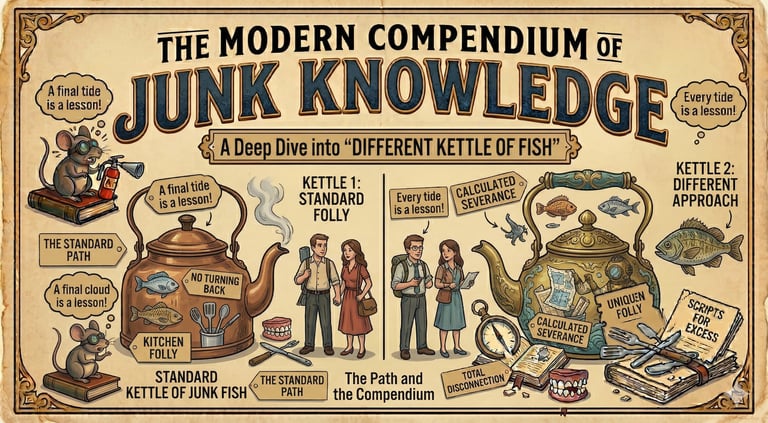
The Definition
A matter that is completely different from the one previously discussed. It describes a shift in topic or circumstances that introduces a new set of complications, rendering the old comparison irrelevant.
The Deep Dive
This phrase is a literal piece of "junk knowledge" from the aristocratic social traditions of 18th-century Scotland. While we now use it to describe a shift in a business deal or a political debate, it began as a specific type of outdoor social event held by the gentry along the banks of rivers like the Tweed.
The "Kettle" Event: A "Kettle of Fish" was essentially an 18th-century riverside picnic. A large open-air kettle (or cauldron) was filled with water, salt, and wine, and set over a fire. Freshly caught salmon were thrown in and boiled whole.
The Messy Reality: Thomas Pennant, in his 1769 Tour in Scotland, described these events as boisterous and disorganized affairs. The "kettle" referred to both the vessel and the chaotic social scene surrounding it.
The "Different" Shift: If a conversation was going one way, and a new, even more chaotic or distinct element was introduced, it was said to be a "different kettle of fish." It implied that the new situation had its own unique "flavor" and set of messy details that didn't fit the previous pot.
The phrase "a fine kettle of fish" (meaning a mess or a muddle) appeared first, popularized by Henry Fielding in his 1742 novel Joseph Andrews. By the time the 1920's arrived, the "different" variation became the standard way to denote a total change in subject matter.
Fast Facts
The Fish Kettle Tool: A "kettle" in this context isn't a tea kettle. It's a specialized, elongated metal pan with a rack inside, designed to cook a whole fish without breaking it.
The "Pretty" Irony: Before it was "different," it was often a "pretty" or "fine" kettle of fish—both used sarcastically to describe a disastrous situation.
The "Other Fish to Fry" Link: This is a linguistic cousin to having "other fish to fry," though that phrase focuses on having more important business elsewhere, rather than just a change in topic.
References
Fielding, H. (1742). The History of the Adventures of Joseph Andrews.
Pennant, T. (1769). A Tour in Scotland. (Description of the riverside "kettle").
Ammer, C. (2013). The Dictionary of Clichés. Skyhorse Publishing.
The Oxford English Dictionary. (2026). Kettle (n.) and Fish (n.). Oxford University Press.