Doesn't Hold a Candle to It
The Definition
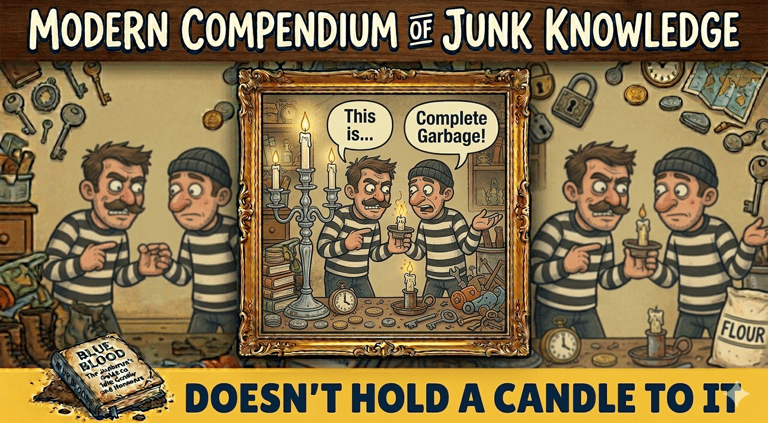
To be compared to something else and found significantly lacking. It is almost always used in the negative ("cannot hold a candle to..."), suggesting that one person or thing is so inferior to another that they aren't even worthy of performing the most menial task for them.
The Deep Dive
This phrase is a literal piece of "junk knowledge" from the centuries before the lightbulb. In the pre-industrial world, almost every skilled trade—from blacksmithing to surgery to fine art—required a steady, focused light source. Since the craftsman needed both hands to work, they relied on a low-level apprentice or servant to stand nearby and hold a tallow candle or a rushlight.
The Lowest Rung: Holding the candle was the most basic, entry-level job in the workshop. It required no skill, only the ability to stand still and follow the master’s movements.
The Comparison: If an apprentice was so clumsy or untalented that they couldn't even manage to hold a candle in the right spot, they were considered utterly worthless.
The Evolution: Over time, the phrase shifted from a literal job description to a metaphorical measurement of quality. To say that a new musician "cannot hold a candle" to a legend like Mozart implies that the newcomer isn't even fit to be Mozart's lowliest assistant.
The phrase was firmly established in English by the mid-1600's. It was famously used by the playwright Sir Edward Sherburne in 1651: "The Moon hath no light... she cannot hold a candle to the Sun." ---
Fast Facts
The "Penny" Candle: In the 18th century, "penny candles" were the cheapest and dimmest light sources available, making the job of "holding" them even more associated with poverty and low status.
A Surgeon’s Light: Before modern operating theaters, medical students would hold multiple candles around a patient so a surgeon could see well enough to operate—a high-pressure version of "holding a candle" where a slip of the hand could be fatal.
The Catholic Link: Some etymologists suggest a connection to "altar boys" holding candles during Mass, but the secular "apprentice" origin is much more widely supported in historical literature.
References
Sherburne, E. (1651). Salmacis, Lyrian & Sylvia, Forsaken Lydia, the Rape of Helen, a Comment Thereon, with Several Other Poems and Translations.
Ammer, C. (2013). The Dictionary of Clichés. Skyhorse Publishing.
Grose, F. (1785). A Classical Dictionary of the Vulgar Tongue. S. Hooper.
The Oxford English Dictionary. (2026). Candle (n.). Oxford University Press.