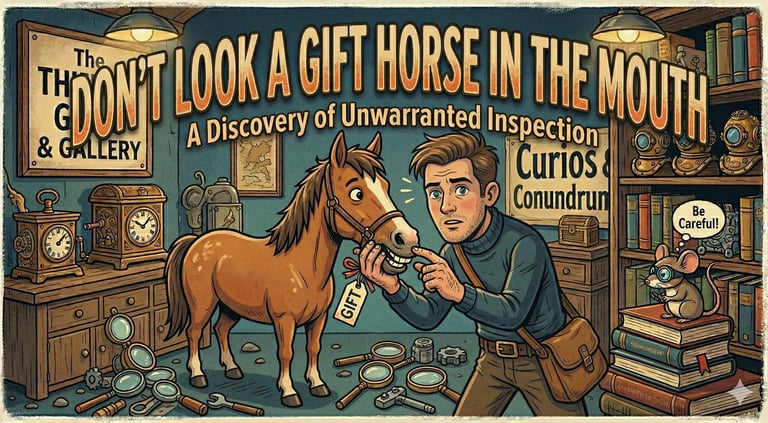
Don't Look a Gift Horse in the Mouth
The Definition
To find fault with something that has been received as a gift. It is a warning against being ungrateful or overly critical when someone has done you a favor or given you something for free.
The Deep Dive
This phrase is a literal piece of "junk knowledge" from the world of pre-industrial transportation. Before odometers and Carfax reports, the only way to verify the age and health of a horse was to examine its teeth.
As a horse ages, its teeth undergo distinct physical changes that are impossible to fake:
The "Galvayne's Groove": A dark groove appears on the outer surface of the upper corner incisor at age 10, reaches the bottom by age 20, and disappears by age 30.
The Angle: Young horses have vertical teeth; as they age, the teeth begin to slant forward at an increasingly sharp angle.
The "Cups": The deep indentations on the chewing surface of the teeth (cups) gradually wear down and disappear in a predictable chronological order.
If you were buying a horse, "looking it in the mouth" was a sign of a savvy, responsible trader. However, if the horse was a gift, performing this inspection was considered the height of rudeness. It signaled to the giver that you didn't trust their generosity and were checking to see if they were offloading a "lemon"—an old, worn-out animal that would cost more in feed and care than it was worth in labor.
Fast Facts
"Long in the Tooth": This related idiom also comes from equine aging; as a horse’s gums recede with age, more of the tooth is exposed, making them literally look "long in the tooth."
Ancient Roots: The phrase is incredibly old. St. Jerome, one of the early Latin Fathers of the Church, used it in the 4th century (Noli equi dentes inspicere donati), suggesting it was already a well-known proverb 1,600 years ago.
The "Mouth" Myth: Some believe it refers to a horse's breath or biting, but the "gift horse" rule is strictly about the "records" written in the enamel.
References
St. Jerome. (c. 392 AD). Commentariorum In Epistolam Ad Ephesios.
Heywood, J. (1546). A Dialogue Conteinyng the Nomber in Effect of All the Prouerbes in the Englishe Tongue.
Ensminger, M. E. (1990). Horses and Horsemanship. Interstate Publishers.
Ammer, C. (2013). The Dictionary of Clichés. Skyhorse Publishing.