Don't Throw the Baby Out
with the Bathwater
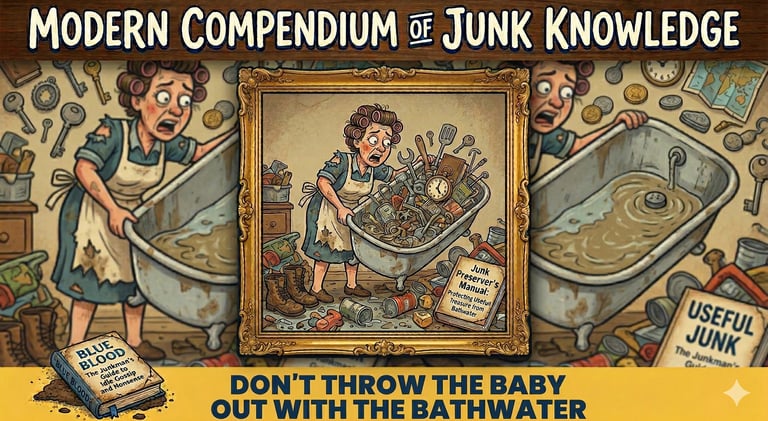
The Definition
A warning against discarding something valuable while trying to get rid of something useless or undesirable. It describes an overzealous "cleanup" or "reform" where the essential core of a project, relationship, or idea is accidentally destroyed along with its flaws.
The Deep Dive
This is a "high-turbidity" piece of junk knowledge that is the subject of one of the most persistent—and likely fabricated—internet myths regarding medieval hygiene.
The "First Bath" Myth (The Junk Legend): A viral "history" email that circulated in the late 1990's claimed that in the 1500's, families shared a single tub of bathwater once a year. The father went first, then the sons, then the women, and finally the infants. By the time it was the baby's turn, the water was allegedly so black and filthy that a mother had to be careful not to accidentally "throw the baby out" when she emptied the tub.
The Historical Reality: This story is almost entirely fiction. While people in the 16th century didn't have indoor plumbing, they weren't remarkably filthy. Most people "washed at the basin" daily. Furthermore, a baby would be bathed in a small, portable basin with fresh (often warmed) water—not at the end of a communal family marathon.
The German Roots (The True Origin): The phrase is actually a literal translation of a German proverb, "Das Kind mit dem Bade ausschütten." It first appeared in print in 1512 in a satirical book by Thomas Murner called Narrenbeschwörung (Appeal to Fools).
The woodcut illustration in Murner’s book shows a literal fool throwing a baby into the street while emptying a basin. The metaphor wasn't about "dirty water" making the baby invisible; it was a satire on people who are so reckless or "foolish" in their actions that they lose sight of what is truly important.
Fast Facts
The "Great Unwashed" Link: This is a linguistic cousin. While "throwing the baby out" is about reckless reform, the "great unwashed" (popularized by novelist Edward Bulwer-Lytton in 1830) was a classist term for the common people.
The "Thomas Carlyle" Connection: The phrase was introduced to the English-speaking world in 1849 by the Scottish historian Thomas Carlyle, who translated the German idiom into English while writing about the abolition of slavery.
The First Print: Thomas Murner's Narrenbeschwörung (1512) contains the earliest known visual and written record of the "baby and bathwater" warning.
References
Murner, T. (1512). Narrenbeschwörung. (The original German satire).
Carlyle, T. (1849). Occasional Discourse on the Negro Question. (The first English usage).
Ammer, C. (2013). The Dictionary of Clichés. Skyhorse Publishing.
The Oxford English Dictionary. (2026). Baby (n.1). Oxford University Press.