Dressed to the Nines
The Definition
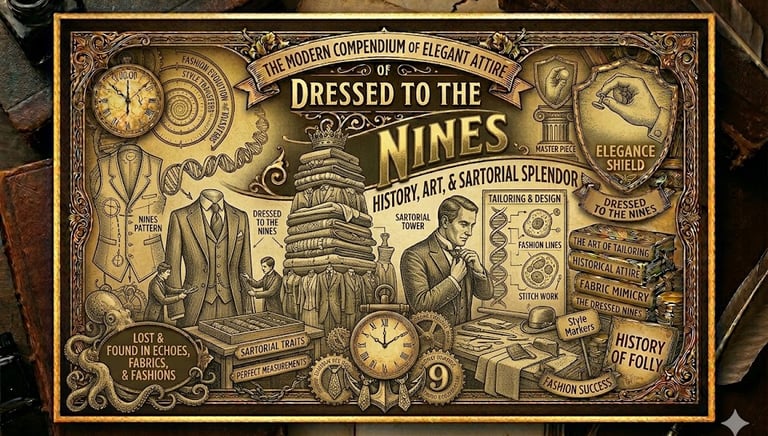
A common idiom used to describe someone who is dressed very fashionably, elaborately, or formally. To be "dressed to the nines" is to have reached the absolute peak of sartorial effort, leaving no detail overlooked and no accessory spared.
The Deep Dive
The "junk knowledge" behind "dressed to the nines" is a subject of fierce etymological debate, with several competing theories that span from the world of high-end tailoring to ancient numerology.
The Tailor’s Yardage Theory: One of the most popular explanations involves the construction of high-quality men’s suits. It was once said that a truly top-tier suit—perhaps one with a waistcoat, extra pockets, and a full lining—required nine yards of fabric. To use all nine yards was to spare no expense, resulting in a person being "dressed to the nines."
The "To the Eyne" Theory: This is a linguistic "junk" favorite. In Old English, the word for "eyes" was eyne. Some scholars argue the phrase was originally "to then eyne" (to the eyes), meaning a person was dressed so well it was pleasing to the sight. Over centuries of verbal "telephone," the phrase morphed into "to the nines."
The "Perfect Number" Theory: In medieval numerology, nine was often considered the number of ultimate completion or perfection because it is three times three (the Trinity). To do anything "to the nines" was to do it perfectly. Before it was specifically about clothing, people were said to "praise to the nines" or "write to the nines."
The phrase reached peak "junk" status in the early 19th century as the "Dandy" movement took hold in London. It represents the "junk" of appearance: the belief that by maximizing your wardrobe, you can transform your entire social standing.
Fast Facts
The "Whole Nine Yards" Cousin: While both phrases use the number nine to represent completeness, "the whole nine yards" is much younger, likely originating in the mid-20th century (possibly related to cement trucks or fighter pilot ammunition belts), whereas "the nines" dates back to at least the 1700's.
The "Sunday Best" Rival: While "Sunday best" refers specifically to church-appropriate attire, "dressed to the nines" implies a more secular, flashy, or "red carpet" level of effort.
The "Tuxedo" Link: The ultimate modern version of being dressed to the nines is the "black tie" event. Interestingly, the tuxedo itself was a "rebellion" against even more formal wear—the "color outside the lines" move of the 1880's.
References
Ammer, C. (2013). The Dictionary of Clichés. Skyhorse Publishing.
Ayto, J. (1990). Dictionary of Word Origins. Arcade Publishing.
Oxford English Dictionary. (2026). The History of Numerical Idioms.