Earning Your Keep
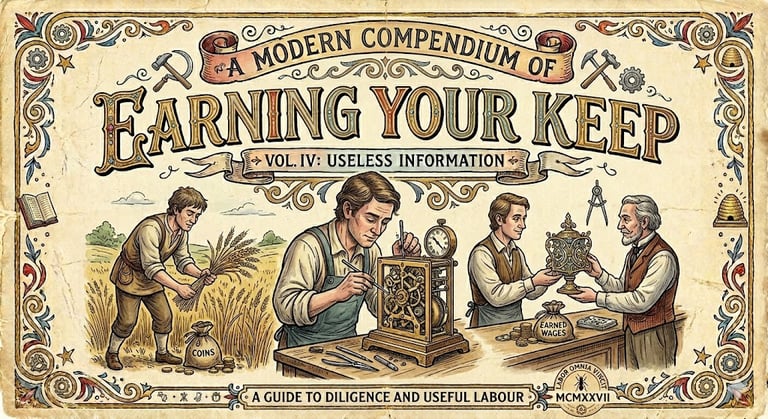
The Definition
A common idiom meaning to perform enough work or provide enough value to justify one’s presence, support, or cost. It is the "brass tacks" of social and economic utility: ensuring that what you contribute to a group or household is at least equal to the "load" you represent in terms of food, housing, and resources.
The Deep Dive
The "junk knowledge" behind "earning your keep" is that it is a feudal and domestic survival metaphor. Before it was used in office performance reviews, it was a literal description of the exchange between a worker and their employer in a "room and board" economy.
The "Keep" as a Place: In medieval architecture, the keep was the innermost, strongest tower of a castle—the ultimate place of safety. To be allowed within the "keep" was a privilege. However, in the context of this idiom, "keep" refers to the cost of maintenance (food, clothing, and shelter).
The Barter of Labor: Before the widespread standardized wages, many laborers were paid in "kind." A farmhand or a domestic servant would receive a bed and three meals a day. If they were lazy or they were not "earning their keep," they were quickly "given the axe."
The "Junk" of Utility: The phrase implies a "zero-sum" balance. It suggests that every individual has a "price tag" based on what they consume. To "earn" that amount is to reach a state of equilibrium.
The phrase reached peak "junk" status during the Great Depression, when every "scrap" of resource mattered. It represents the "junk" of meritocracy: the idea that no one gets a "free ride" and that even the "birds" must contribute to the nest.
Fast Facts
The "Worth Your Salt" Rival: This is the ancient Roman version of the same idea. Soldiers were sometimes paid in salt (salarium, the root of "salary"). If they were good soldiers, they were "worth their salt."
The "Sing for Your Supper" Connection: This variation suggests that if you don't have manual labor to offer, you must offer entertainment or "junk" talent to justify your meal.
The Machine Age Evolution: Today, we often apply this phrase to inanimate objects. If a piece of software or a professional tool doesn't save you more time than it costs to maintain, it isn't "earning its keep."
References
Ammer, C. (2013). The Dictionary of Clichés. Skyhorse Publishing.
Oxford English Dictionary. (2026). The Evolution of Domestic Labor Terms.
Tusser, T. (1557). Five Hundred Points of Good Husbandry.