Easy as Pie
The Definition
Something that is extremely simple to accomplish; a task that requires little to no effort or specialized skill. It implies a sense of pleasant, rewarding ease.
The Deep Dive
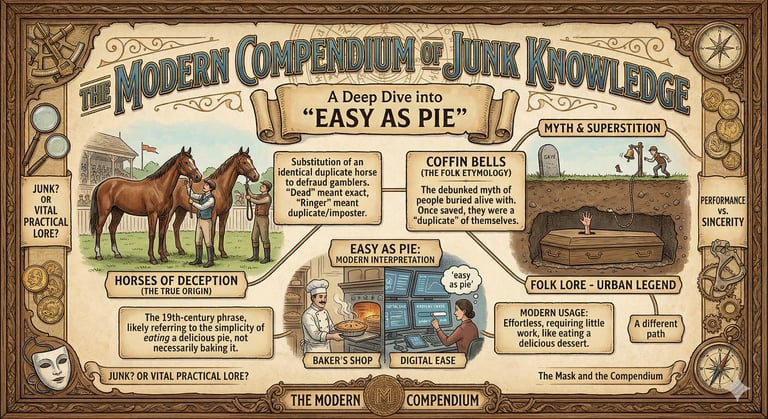
This is a classic piece of "junk knowledge" that highlights a linguistic shift in the American South during the mid-to-late 19th century. While we now use it for fixing a computer or folding a shirt, the origin has nothing to do with the making of the pie—which, as any baker knows, involves the finicky chemistry of cold butter and flour.
The Eating, Not the Baking: The "ease" refers entirely to the consumption of the pie. In the 1800's, pie was a staple of the American diet, often served at every meal, including breakfast. It was the ultimate "convenience food" of the era—soft, sweet, and required very little "work" to chew or digest compared to the tough meats and coarse grains of the frontier.
The "Nice" Connection: Before it was "easy," the common phrase was "as nice as pie." In the 1870's and 80's, "nice" didn't just mean pleasant; it meant "perfect" or "well-executed." If a situation was "nice as pie," it was going exactly as planned.
The specific "easy" variation first appeared in print in the 1880's. It is a direct linguistic cousin to "a piece of cake" (1930's) and "as easy as falling off a log." By the time it was used in Mark Twain’s era, "pie" had become the universal American metaphor for anything that provided maximum reward for minimum effort.
Fast Facts
The First Print: One of the earliest recorded uses is from the Saratogian newspaper in 1887: "You'll find it as easy as eating pie."
The "Cake" Evolution: "A piece of cake" didn't emerge until nearly 50 years later, popularized by the British Royal Air Force (RAF) to describe an easy mission.
The "Duck" Alternative: In the same period, you might have heard someone say "easy as kiss my hand" or "easy as shellin' peas," though "pie" ultimately won the popularity contest.
References
Twain, M. (1884). The Adventures of Huckleberry Finn. (General usage of "pie" metaphors).
Flexner, S. B. (1982). Listening to America. Simon & Schuster.
Ammer, C. (2013). The Dictionary of Clichés. Skyhorse Publishing.
The Oxford English Dictionary. (2026). Pie (n.1) and Easy (adj.). Oxford University Press.