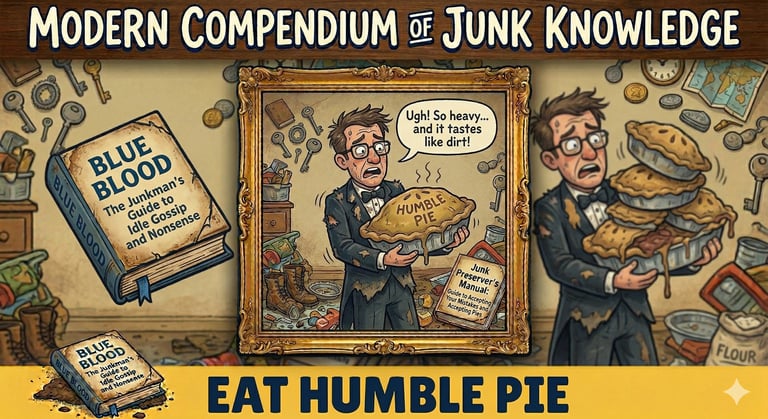
Eat Humble Pie
The Definition
To admit one's errors, apologize submissively, or accept a humiliating defeat. It describes the act of "swallowing" one's pride after being proven wrong or lowered in status.
The Deep Dive
The "junk knowledge" myth often assumes this phrase refers to the personality trait of being "humble." While the sentiment fits, the origin is a literal, physical dish served in the great halls of Medieval England. The word "humble" is a linguistic evolution of the word "umbles."
In the 14th and 15th centuries, after a successful hunt, the lord of the manor and his high-ranking guests would feast on the choice cuts of the deer—the haunch and the venison. The less desirable parts, specifically the heart, liver, kidneys, and entrails, were known as the numbles (from the Old French nomble, meaning loin or innards).
The Class Divide: The "numbles" were given to the servants and the lower-class laborers, who would chop them up and bake them into a thick, heavy pastry crust.
The "Umble" Shift: Over time, "a numble pie" was misheard as "an umble pie." Because the dish was associated with the poor and the servant class, "eating umble pie" became a powerful metaphor for being brought low or being forced to eat the food of commoners.
By the early 1800's, the pun was too perfect to ignore. The word umble (the offal) and the word humble (the virtue) merged in the public consciousness. To eat the pie was no longer just about your dinner; it was about the state of your ego.
Fast Facts
The "L" Factor: In many British dialects, the "H" in humble is silent, making umble and humble phonetically identical, which helped seal the linguistic deal.
Samuel Pepys: The famous 17th-century diarist Samuel Pepys recorded eating "umble pie" in 1663, noting that he "ate very well" of it, suggesting that despite its lowly reputation, it could be quite flavorful.
The "Offal" Truth: Today, "umble" remains a culinary term in some traditional British recipes, though most modern diners prefer to eat their "humble pie" metaphorically.
References
Pepys, S. (1663). The Diary of Samuel Pepys. (July 5 entry).
Grose, F. (1811 edition). Dictionary of the Vulgar Tongue.
Ammer, C. (2013). The Dictionary of Clichés. Skyhorse Publishing.
The Oxford English Dictionary. (2026). Umble (n.) and Humble (adj.). Oxford University Press.