Eighty Six It
The Definition
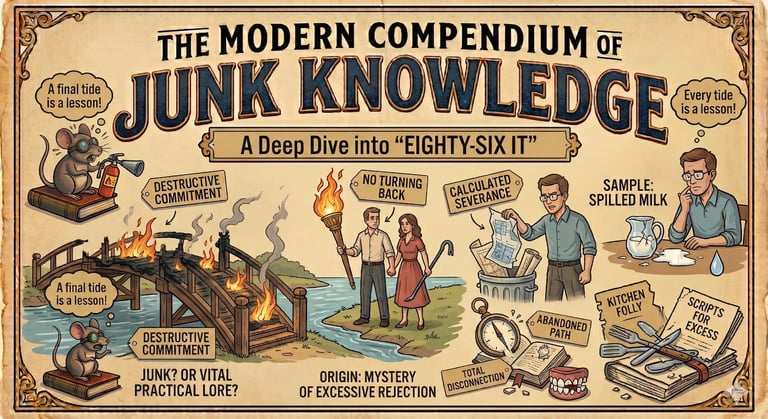
To eject, discard, or cancel something. In a restaurant, it means an item is out of stock; in a bar, it means a patron is banned; in a script, it means a scene is cut. It is the ultimate "delete" button of the service industry.
The Deep Dive
This phrase is a "mystery meat" of junk knowledge, with at least five competing theories that have seasoned its history. While everyone agrees it means "get rid of it," no one can quite agree on the recipe for its origin.
The Chumley’s Exit: The most popular New York legend centers on Chumley’s, a famous Prohibition-era speakeasy located at 86 Bedford Street. When the police were about to raid the joint, the bartender would yell "86!" as a signal for patrons to bolt out the back door onto Bedford Street to avoid arrest.
The Soda Fountain Code: In the 1920's and 30's, busy "luncheonettes" used a numerical shorthand to communicate over the din of the crowd. "86" was rumored to be code for "we're out of that item." Why 86? Some say it rhymed with "nix" (to cancel), while others point to the Article 86 of the New York State Liquor Law, which dealt with the circumstances under which a patron should be refused service.
The Naval Scrapping: A grittier theory points to the U.S. Navy, where "86" referred to the "86'ing" of a ship—the process of stripping it for parts and decommissioning it.
The Grave Reality: The darkest (and likely most "junk") theory suggests it refers to the standard dimensions of a grave: eight feet long and six feet deep. To "86" someone was to metaphorically bury them.
The phrase first appeared in print in the early 1940's, specifically in the American Speech journal, which identified it as "soda fountain lingo." By the 1950's, it had migrated from the kitchen to the Hollywood studio and the boardroom.
Fast Facts
The Rhyme Scheme: Linguists favor the "nix" theory. In the high-speed world of a 1930's diner, "86" was much easier to shout and hear than "We are currently unable to fulfill your request for the ham sandwich."
The "99" Counterpart: In the same era of diner slang, "99" was code for the manager—meaning "look sharp, the boss is coming."
The 86-Cent Standard: Another theory suggests that 86 cents was the price of a standard meal in a specific 19th-century military canteen, and once you reached that limit, you were "cut off."
References
Wentworth, H., & Flexner, S. B. (1960). Dictionary of American Slang. Crowell.
American Speech. (1944). Vol. 19, No. 3: Soda-Fountain Lingo.
Ammer, C. (2013). The Dictionary of Clichés. Skyhorse Publishing.
The Oxford English Dictionary. (2026). Eighty-six (v.). Oxford University Press.