Eleventh Hour
The Definition
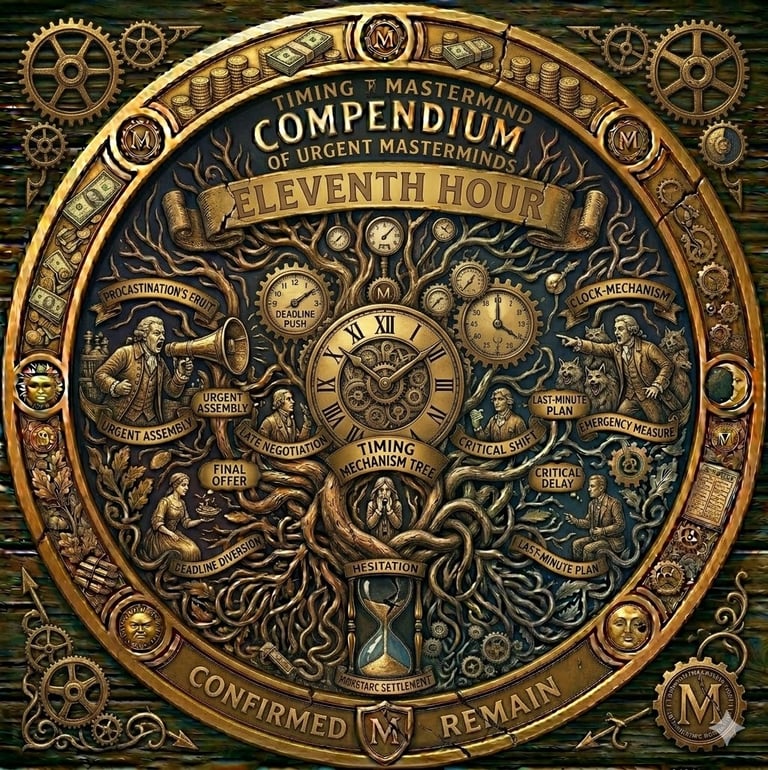
A common idiom referring to the latest possible moment before it is too late; a "close shave" with a deadline. It describes a situation where a decision is made or an action is taken at the very end of a countdown, often narrowly avoiding a "what's done is done" disaster.
The Deep Dive
The "junk knowledge" behind the "eleventh hour" is that it is a biblical measurement of time from a world that didn't use 24-hour digital clocks. It stems from ancient labor practices.
The Parable of the Workers: The phrase originates from the New Testament (Matthew 20), in the Parable of the Vineyard. In this story, a landowner hires laborers at various times of the day. The "day" was divided into twelve hours of daylight. The final group of workers is hired at the "eleventh hour"—with only one hour of work left before sunset.
The "Junk" of Equal Pay: The "low blow" of the story (at least to the all-day workers) was that the eleventh-hour workers received the same reward as those who had worked through the heat of the day. This cemented the "eleventh hour" as a symbol of a last-minute opportunity or a "save" that occurs just before the "axe" falls.
The "Midnight" Distinction: While we often think of "midnight" as the final hour today, the ancient "eleventh hour" was specifically the final hour of opportunity before the darkness of night made work impossible.
The phrase reached peak "junk" status in the world of 20th-century diplomacy and journalism. It represents the "junk" of procrastination: the reality that many of the world's most important "brass tacks" agreements aren't settled until the "flock" is staring directly at the deadline.
Fast Facts
The "Last Minute" Rival: While "last minute" is generic, "eleventh hour" carries a more dramatic, almost "barking mad" sense of urgency and gravity.
The "Under the Wire" Connection: This is the horse-racing version of the same idea. It refers to a horse's nose crossing the finish line "wire" at the absolute last second to secure a win.
The Armistice Link: World War I ended at the 11th hour of the 11th day of the 11th month in 1918. This historical "coincidence" gave the "eleventh hour" a permanent association with the cessation of conflict and a "close shave" with peace.
References
Matthew 20:1-16. The Holy Bible.
Ammer, C. (2013). The Dictionary of Clichés. Skyhorse Publishing.
Oxford English Dictionary. (2026). The Transition of Biblical Timekeeping to Modern Idiom.