Even Keel
The Definition
To be in a state of balance, calm, or steady progress. A person on an "even keel" is someone who remains unruffled by stress or external chaos, maintaining a consistent course without "tipping" into extremes.
The Deep Dive
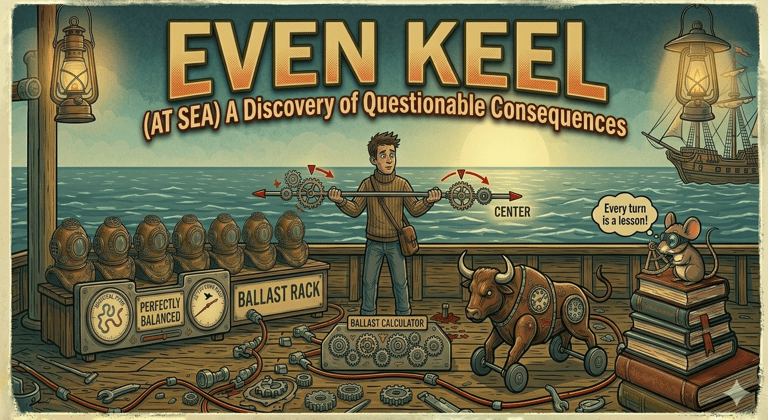
The term is a literal description of a ship's physical orientation in the water. The keel is the heavy, structural backbone of a vessel, running along the center of the bottom from bow to stern. It acts as a counterweight to the wind in the sails and keeps the ship from blowing sideways or capsizing.
A ship is on an even keel when its draft (the depth it sits in the water) is the same at the front (bow) and the rear (stern), and it is not leaning (heeling) to the left or right.
The Importance of Trim: If a ship is not on an even keel—perhaps because the cargo has shifted or the "three sheets to the wind" are causing it to lean—it becomes sluggish, difficult to steer, and prone to taking on water.
The Metaphor: Sailors used "even keel" to describe a well-handled, predictable ship. By the mid-1800's, the phrase was adopted by land-dwellers to describe people who possessed a similar internal "ballast." It implies that despite the "waves" of life, the person's center of gravity remains low and steady.
The phrase transitioned from a shipwright’s technical measurement to a psychological compliment, famously appearing in 19th-century literature and naval journals to describe reliable officers.
Fast Facts
The Physics: The keel is often weighted with lead or iron. This "ballast" is what allows a sailboat to lean nearly 45 degrees without flipping over.
The Modern Keel: High-performance racing yachts now use "canting keels" that move from side to side to intentionally keep the boat on an even keel even in extreme winds.
The Opposite: A ship that is "crank" or "tender" is the opposite of an even keel—it's top-heavy, unstable, and likely to "fly off the handle" in a gust of wind.
References
Dana, R. H. (1841). The Seaman's Friend: Containing a Treatise on Practical Seamanship. Little, Brown.
Jeans, P. D. (2004). Ship to Shore: A Dictionary of Pictorial Maritime Grammar. McGraw-Hill.
Smyth, W. H. (1867). The Sailor's Word-Book: An Alphabetical Digest of Nautical Terms. Blackie and Son.
The Oxford Companion to Ships and the Sea. (2006). Oxford University Press.