Extinction of 1681
The Definition
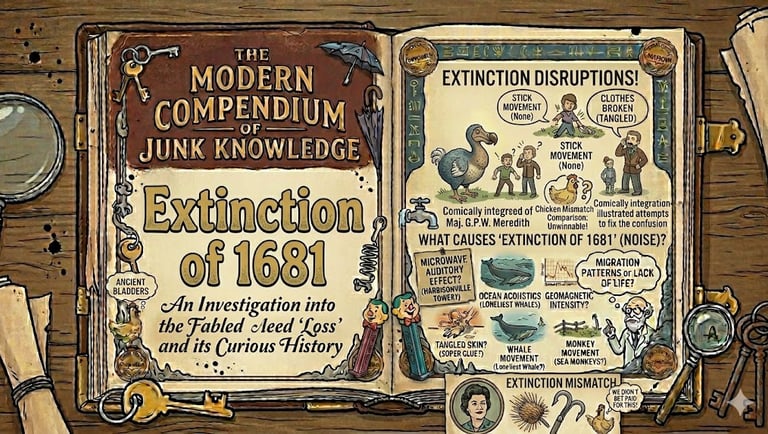
The year 1681 is widely cited as the date of the last credible sighting of a living Dodo (Raphus cucullatus), a flightless bird endemic to the island of Mauritius. Its disappearance remains the most iconic example of human-induced extinction, representing the moment humanity realized that a species could be wiped off the face of the Earth forever.
The Deep Dive
The "junk knowledge" behind the extinction of 1681 is that the Dodo wasn't actually "stupid" or "fat," despite centuries of propaganda. Its reputation as a bumbling, doomed bird was largely a smear campaign by the sailors and settlers who found it easy to catch.
The Evolution of Isolation: For millions of years, the Dodo lived on Mauritius with no natural predators. It lost the ability to fly because it didn't need to escape anything. It nested on the ground because there were no egg-eating mammals. This "evolutionary luxury" became its downfall when the Dutch arrived in 1598.
The "Dead as a Dodo" Myth: We often imagine humans hunted the Dodo into extinction because it was a tasty delicacy. In reality, Dutch sailors called it Walgvogel ("disgusting bird") because the meat was tough and greasy. The Dodo’s real killers were the "junk" of human travel: pigs, rats, dogs, and macaques that escaped from ships and ate the Dodo’s eggs and chicks.
The 1681 Sightline: The date 1681 comes from the journal of Benjamin Harry, a British sailor aboard the ship Berkeley Castle. He described seeing the bird during a stopover on the island. While some statistical models suggest a few individuals may have lingered until the 1690's, Harry's account is generally accepted as the "final bell" for the species.
The Dodo reached peak "junk" status in the 19th century after appearing in Lewis Carroll’s Alice’s Adventures in Wonderland. It represents the "junk" of biological history: a creature so perfectly adapted to its home that it became a helpless relic the moment the world outside its island knocked on the door.
Fast Facts
The Mummified Foot: For over a century, the only physical remains of a Dodo with soft tissue were kept at the Oxford University Museum of Natural History. In a tragic bit of irony, the specimen was so badly maintained that most of it was thrown away in 1755, leaving only a head and a foot behind.
The Calvaria Tree Mystery: For years, scientists believed the Sideroxylon grandiflorum tree was also going extinct because its seeds supposedly only germinated after passing through a Dodo's digestive tract. This turned out to be "junk science"; the tree's decline was actually due to different environmental factors, and the seeds can germinate without the bird.
The Pigeon Connection: DNA testing has revealed that the Dodo's closest living relative is the Nicobar Pigeon, a vibrant, flying bird. This proves the Dodo was essentially a "pigeon that grew large and stopped flying."
References
Cheke, A. S., & Hume, J. P. (2008). Lost Land of the Dodo. Yale University Press.
Quammen, D. (1996). The Song of the Dodo: Island Biogeography in an Age of Extinctions.
Oxford University Museum of Natural History. (2026). The Dodo: Icon of Extinction.