Fields Have Eyes
The Definition
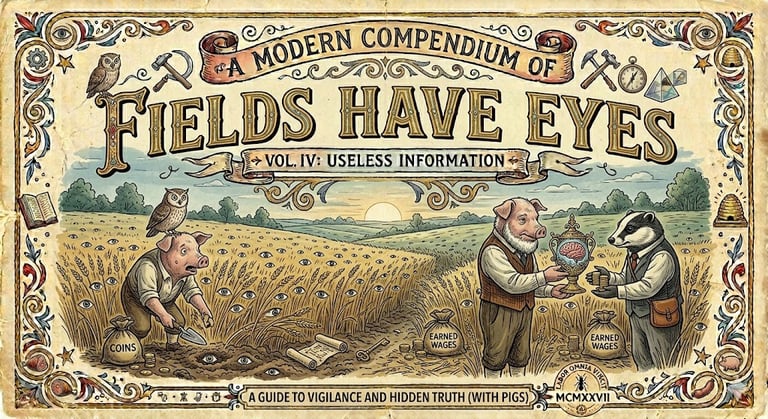
This proverb serves as a warning that one is never truly alone and that secrets are rarely safe, even in seemingly desolate or open spaces. It suggests that witnesses may be hidden in the environment, emphasizing the need for discretion regardless of the perceived privacy of a location.
The Deep Dive
The expression is a lesson in vigilance that dates back to the Middle Ages, appearing in various forms across several European languages.
Chaucerian Roots: One of the earliest recorded versions in English appears in Geoffrey Chaucer’s The Knight's Tale (c. 1385), where he writes, "Field hath eyes, and the wood hath ears." This poetic warning reminded travelers and conspirators that the natural landscape could harbor spies, poachers, or rivals concealed by the terrain.
The "Hedge" Connection: In the era before modern surveillance, "eavesdropping" was a literal act of standing under the eaves of a house or hiding in a hedgerow to listen to private conversations. The idea that "fields have eyes" reinforced the belief that even the open countryside offered no guarantee of secrecy, as the general public or the crown's agents could be anywhere.
Global Variations: The sentiment is universal. A common Hebrew proverb notes that "The path has ears," while a Persian variation suggests that "Walls have mice, and mice have ears." Each culture uses its most common environment to warn that secrecy is almost impossible to maintain.
Fast Facts
The "Walls Have Ears" Rival: While "fields have eyes" focuses on visual surveillance in open spaces, "walls have ears" focuses on auditory surveillance in domestic or urban settings. Both highlight the same fundamental lack of privacy.
The Paranoid King: Historical anecdotes often attribute the "walls have ears" variant to Catherine de' Medici or King Catherine of France, who allegedly had secret listening tubes built into the walls of her palace to ensure no conversation remained private.
References
Chaucer, G. (c. 1385). The Canterbury Tales.
Ammer, C.. (2013). The Dictionary of Clichés. Skyhorse Publishing.
Heywood, J. (1546). A Dialogue Conteinyng the Nomber in Effect of all the Prouerbes in the Englishe Tongue.