Five Second Rule
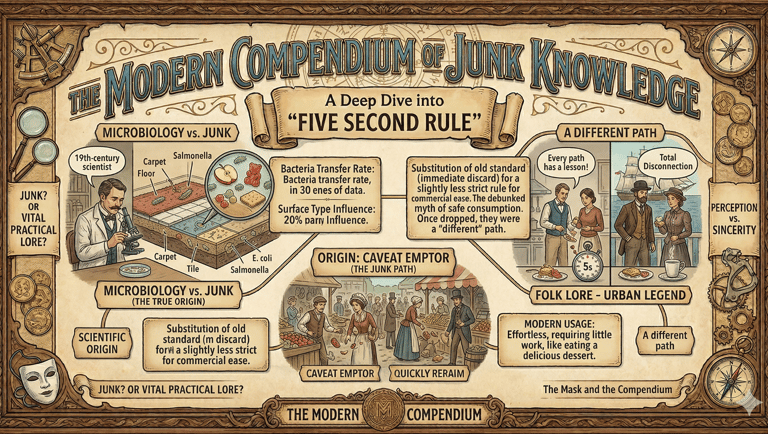
The Definition
A widely held (and scientifically dubious) social "rule" that food dropped on the floor remains uncontaminated and safe to eat if it is picked up within five seconds. It implies that bacteria require a "travel time" or a "grace period" before they can successfully migrate from the ground to your snack.
The Deep Dive
This is a literal piece of "junk knowledge" that exists at the intersection of desperation and pseudoscience. While most people use it as a humorous excuse to save a fallen cookie, the "rule" has been the subject of serious academic study, most notably by researchers at Clemson University and Rutgers University.
The Transfer Reality: The "junk" in the rule is the idea of time. Bacteria, such as Salmonella or E. coli, do not have a five-second delay. They are microscopic and don't "run" toward the food; they are transferred instantaneously upon contact.
The Surface Factor: The type of floor matters more than the clock. Surprisingly, carpet is safer than tile or wood. Carpet has a lower "transfer rate" because the fibers hold the bacteria deep in the pile, whereas a flat, hard surface allows for maximum surface area contact with the food.
The Moisture Trap: The "stickier" the food, the higher the risk. A piece of wet watermelon will pick up significantly more bacteria in one second than a dry cracker will in thirty seconds.
While the origin of the "five seconds" is unknown, some folklore historians point back to Genghis Khan, who supposedly declared that food prepared for him was so special that it could stay on the ground for five hours and still be fit for a king. Over the centuries, as our understanding of germs improved (and our patience shortened), the "five hours" became "five seconds."
Fast Facts
The Gender Gap: Studies have shown that women are more likely than men to invoke the Five-Second Rule to save fallen food, particularly if the food is a sweet treat like chocolate.
The "Clear" Floor Myth: Even a floor that looks clean can harbor millions of bacteria. "Clean" is a visual standard; "sterile" is a biological one.
The 2003 Ig Nobel Prize: High school student Jillian Clarke won the Ig Nobel Prize for Public Health for her early research into the rule, proving that even a "clean" floor at the University of Illinois was teeming with microbes.
References
Dawson, P., et al. (2007). Residence Time and Food Contact Time Effects on Transfer of Salmonella Typhimurium from Tile, Wood and Carpet: Testing the Five-Second Rule. Journal of Applied Microbiology.
Schaffner, D. (2016). Longer Contact Time Increases Microbial Transfer to Food. Rutgers University Study.
Ammer, C. (2013). The Dictionary of Clichés. Skyhorse Publishing.
The Oxford English Dictionary. (2026). Rule (n.1). Oxford University Press.