Flash in the Pan
The Definition
A sudden, brief success that is not repeated or sustained. It describes something—a pop star, a business trend, or a sports performance—that shows great promise for a fleeting moment but ultimately fails to deliver a lasting result.
The Deep Dive
While we now use this for a "one-hit wonder" on the music charts, the "junk knowledge" behind this phrase is a literal, mechanical failure of 17th-century weaponry. Before the invention of the percussion cap or the modern cartridge, muskets and pistols used a flintlock mechanism.
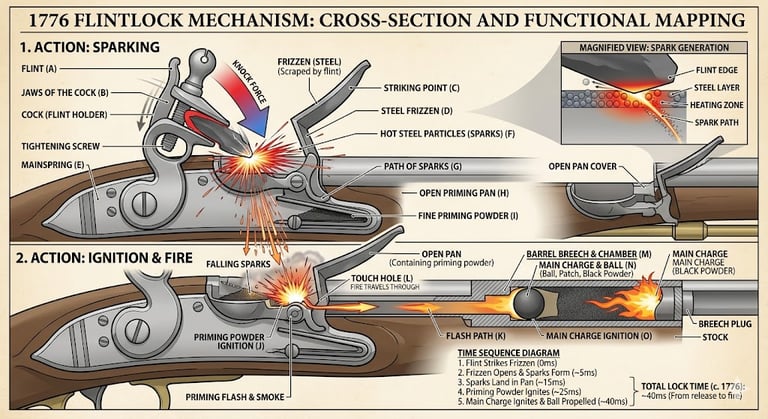
To fire a flintlock, a small amount of gunpowder was placed in a shallow external "priming pan." When the trigger was pulled, a piece of flint struck a steel frizzen, creating sparks that were supposed to ignite the priming powder.
The Ignition: Ideally, the fire from the priming pan would travel through a small "touch-hole" into the main barrel, igniting the primary charge and firing the lead ball.
The "Flash": Sometimes, however, the powder in the pan would flare up with a bright, impressive flash of light and smoke, but the fire would fail to reach the main charge. The result was a dramatic "flash in the pan" with no actual shot fired. The weapon was useless, and the soldier or hunter was left standing in a cloud of smoke.
A secondary (and equally "junky") theory comes from the California Gold Rush. Prospectors would swirl gravel and water in a metal pan, hoping to see the "flash" of gold at the bottom. Often, what they saw was "fool's gold" (pyrite) or a tiny flake that looked like a massive find but turned out to be worthless. However, the military usage predates the Gold Rush by nearly 150 years.
Fast Facts
The "Dud" Link: This is a linguistic cousin to the "dud," a term that emerged in WWI for an explosive shell that failed to detonate.
The First Print: The phrase appeared in 1706 in a satirical poem, used to describe a political argument that had plenty of noise but no substance.
The "Going Off Half-Cocked" Connection: Another flintlock-era phrase. A gun "half-cocked" was in a safety position; if it fired anyway, it was premature and dangerous—much like a person acting before they are fully prepared.
References
Moxon, J. (1683). Mechanick Exercises. (On the mechanics of firearms).
Ammer, C. (2013). The Dictionary of Clichés. Skyhorse Publishing.
Flexner, S. B. (1982). Listening to America. Simon & Schuster.
The Oxford English Dictionary. (2026). Flash (n.1) and Pan (n.1). Oxford University Press.