Fly in the Ointment
The Definition
A small defect or drawback that spoils an otherwise valuable or pleasant situation. It refers to a minor annoyance that has a disproportionately large negative effect on the whole.
The Deep Dive
Like many of our most enduring "junk knowledge" idioms, this one began as a literal observation in the ancient world before becoming a global metaphor for a "spoiler." Its origins are found in the Old Testament, specifically the Book of Ecclesiastes (10:1), written roughly 2,300 years ago.
In the ancient Near East, "ointment" wasn't just a basic salve for a cut; it was a highly expensive, perfumed oil used for religious anointing, burial rites, and luxury skincare. These ointments were often made from rare resins like myrrh and frankincense.
The Fermentation of Filth: The biblical verse reads: "Dead flies cause the ointment of the apothecary to send forth a stinking savour: so doth a little folly him that is in reputation for wisdom and honour."
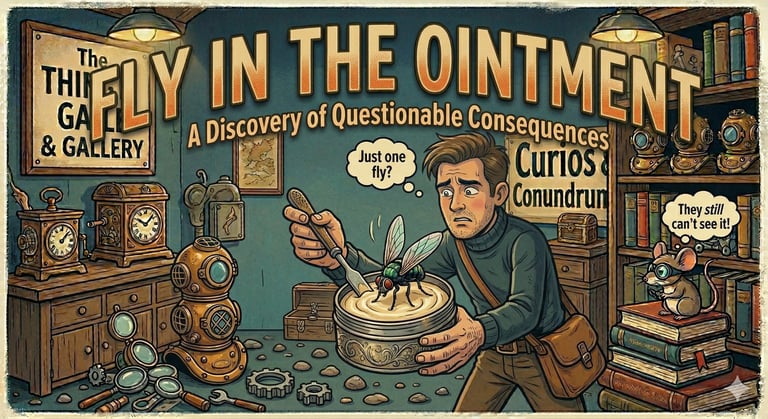
The Chemical Reaction: Because these precious oils were organic, a single dead insect—attracted by the sweet scent—could introduce bacteria that would cause the entire jar to ferment and rot. A tiny, worthless fly could turn a vessel worth a year’s wages into a rancid, stinking mess.
The phrase was popularized in the English-speaking world by the King James Bible in 1611. While we no longer worry about flies ruining our expensive perfumes, the logic remains: a single "dead fly" (a bad piece of news, a rude guest, or a technical glitch) can ruin the "ointment" of a wedding, a vacation, or a business deal.
Fast Facts
The "Small" Factor: The power of the idiom lies in the scale—the fly is tiny and insignificant on its own, yet its impact is total.
The Modern Version: In the 20th century, the phrase "a wrench in the works" became the industrial-age equivalent, though it implies a mechanical breakdown rather than a sensory "spoiling."
Apothecary Art: In the 17th century, the "Apothecary" was a combination of a pharmacist and a chemist; a fly in the ointment was a sign of a sloppy, unprofessional shop.
References
The Bible. (King James Version). Ecclesiastes 10:1.
Tyndale, W. (1530). The Practice of Prelates. (Early idiomatic usage).
Ammer, C. (2013). The Dictionary of Clichés. Skyhorse Publishing.
Manser, M. H. (2007). The Facts on File Dictionary of Proverbs. Facts on File.