Fool's Errand
The Definition
A fool’s errand is a task that is fundamentally pointless, impossible to complete, or based on a deceptive premise. It describes a situation where an individual is sent to search for something that does not exist, often as a practical joke or a "brass tacks" test of their gullibility.
The Deep Dive
The history of the "fool’s errand" is inextricably linked to the traditions of trade apprenticeships and seasonal festivals, where hazing rituals were a common method of establishing social hierarchies.
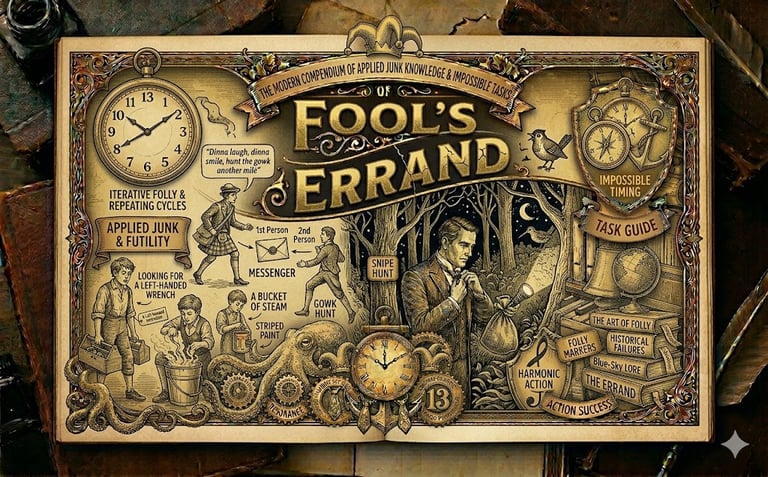
Apprentice Hazing: Historically, seasoned craftsmen would send a new apprentice on a "fool's errand" to find a non-existent tool. Common examples included searching for a "left-handed wrench," a "bucket of steam," or "striped paint." The errand served to humble the newcomer and provide entertainment for the rest of the workers.
The "Hunting the Gowk" Tradition: In Scotland, April Fools' Day was traditionally known as "Hunt the Gowk Day" (a gowk being a cuckoo or a fool). A person would be sent to deliver a sealed message that supposedly contained an urgent request. The recipient would read the note—which simply said, "Dinna laugh, dinna smile, hunt the gowk another mile"—and send the messenger to another person, continuing the errand indefinitely.
The "Junk" of Futility: Unlike a tall order, which is a difficult but possible task, a fool's errand is defined by its inherent impossibility. It is a psychological exercise designed to demonstrate that the person performing the task lacks the critical thinking to realize they are being deceived.
Fast Facts
The Sniper Hunt: In various military traditions, new recruits are often sent on a fool's errand to find "prop wash," "grid squares," or "exhaust samples," serving as a modern continuation of the apprentice ritual.
Snipe Hunting: A classic American version of the fool’s errand involves taking someone "snipe hunting" in the woods at night with a burlap bag and a flashlight. While snipes are real birds, the method of catching them described to the victim is entirely fictitious.
References
Ammer, C. (2013). The Dictionary of Clichés. Skyhorse Publishing.
Brand, J. (1813). Observations on Popular Antiquities.
Oxford English Dictionary. (2026). The Sociology of Workplace Rituals and Practical Jokes.