Get on a Soapbox
The Definition
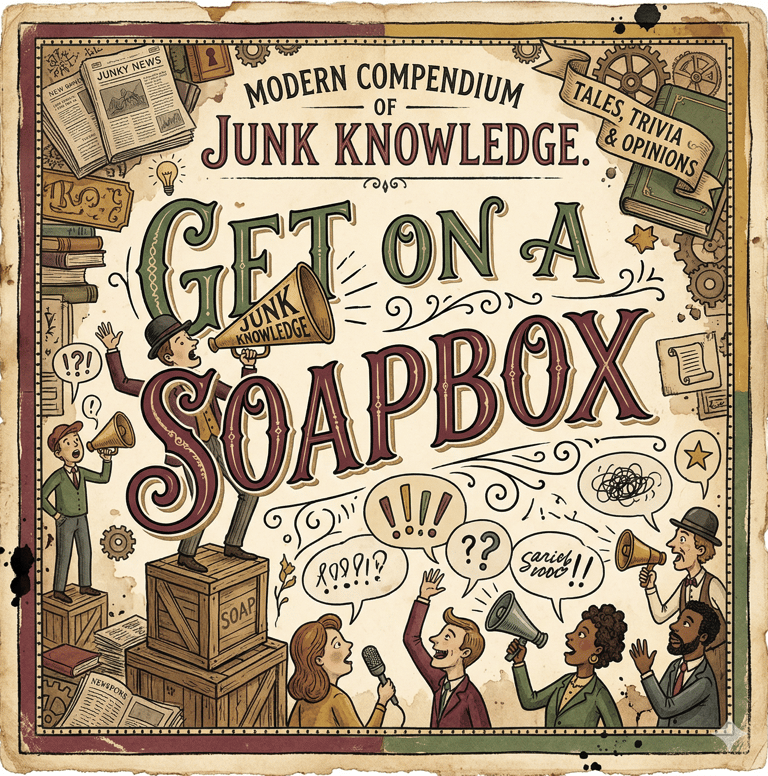
To express one’s opinions in a loud, passionate, or dogmatic manner, often to an audience that didn't necessarily ask for them. It describes a person who has seized a moment to lecture others on a "pet cause" or a political grievance.
The Deep Dive
This is a literal piece of "junk knowledge" from the crowded, noisy street corners of Victorian London and Pre-War New York. Before the era of social media, podcasts, or even widespread radio, if you had a message for the masses, you had to physically go to them.
In the 19th and early 20th centuries, goods like soap and tobacco were shipped to general stores in sturdy, standardized wooden crates.
The Elevated Platform: Because the streets were crowded and noisy, a speaker standing on the pavement would be invisible and unheard. To "command the room" (or the sidewalk), an aspiring orator would grab an empty wooden soap crate from behind a local grocer.
The "Soap" Standard: Why soap? Soap was one of the first mass-produced consumer goods shipped in bulk. The crates were ubiquitous, lightweight enough to carry, but strong enough to support the weight of a grown man.
The "Speakers' Corner": The most famous location for this was Hyde Park in London, where since 1872, anyone has been legally allowed to stand on a box and speak on any subject they choose—provided they don't use profanity or incite a riot.
The phrase moved from a physical description of a street preacher to a metaphorical description of anyone "lecturing" others by the early 1900's. Even though modern "soapboxes" are made of digital pixels rather than pine wood, the term remains the universal shorthand for unsolicited public opinion.
Fast Facts
The "Stump" Speech: This is the rural cousin to the soapbox. In the American frontier, politicians would stand on the stumps of recently cleared trees to address a crowd of settlers, giving us the term "stump speech."
The First Print: The term "soap-box" as a verb appeared in American newspapers as early as 1907, specifically describing socialist and labor union organizers in New Jersey.
The Digital Soapbox: In the late 1990's, "Soapbox" was one of the early names for various blogging and video-sharing platforms, acknowledging the term's roots in free, independent speech.
References
Pickering, P. A. (2001). The People's Bread: A History of the Anti-Corn Law League. (On early street oratory).
Ammer, C. (2013). The Dictionary of Clichés. Skyhorse Publishing.
Flexner, S. B. (1982). Listening to America. Simon & Schuster.
The Oxford English Dictionary. (2026). Soap-box (n. and v.). Oxford University Press.