Get Sacked
The Definition
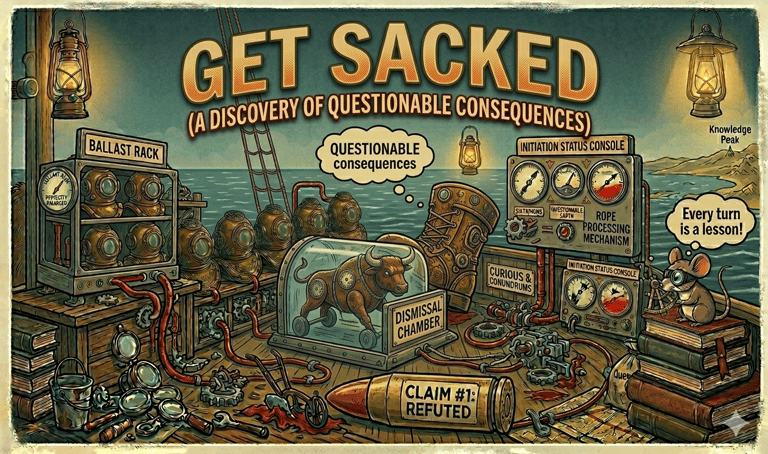
To be summarily dismissed from one’s employment. While now used for everyone from football managers to office clerks, the phrase implies a sudden, often unceremonious, ejection from a workplace.
The Deep Dive
The "junk knowledge" myth often suggests this comes from the "Sack of Rome" or ancient military plundering. In reality, the origin is far more domestic and practical, rooted in the nomadic nature of 17-century master craftsmen and laborers.
Before the Industrial Revolution, many skilled tradesmen (carpenters, stonemasons, and mechanics) traveled from job to job carrying their own personal tools. To transport these heavy, specialized implements, a worker would own a large, sturdy canvas sack.
The Security Deposit: When a worker was hired for a long-term project, he would often leave his tool sack in the employer’s workshop or a secure "tool room" as a gesture of commitment.
The Dismissal: If a worker’s performance was unsatisfactory, the employer would literally hand the man back his bag. To "get the sack" meant you were being given your belongings and told to move on. Once you had your sack in hand, you were no longer part of the crew; you were just a traveler with a bag of heavy iron.
The phrase transitioned from the trades into general Victorian slang. By the mid-1800's, even domestic servants and clerks—who didn't necessarily carry tool bags—were described as "getting the sack" when they were fired.
Fast Facts
The French Connection: A similar phrase exists in French (sacquer), which dates back even further to the 15th century, suggesting this was a universal custom across European guilds.
The "Pink Slip" Evolution: In the early 20th century, the "sack" was replaced by the "pink slip"—a carbon copy of a termination notice—but the older, more visceral idiom survived.
The Sports Twist: In American football, "sacking" the quarterback was coined by Hall of Famer Deacon Jones in the 1960's, intending to evoke the devastation of a city being plundered (a "sack"), merging the two historical meanings.
References
Grose, F. (1785). A Classical Dictionary of the Vulgar Tongue. S. Hooper.
Mayhew, H. (1851). London Labour and the London Poor. George Woodfall and Son.
Taggart, C. (2010). An Applied Dictionary of Idioms. Michael O'Mara Books.
The Oxford English Dictionary. (2026). Sack (v.3). Oxford University Press.