Get the Hook
The Definition
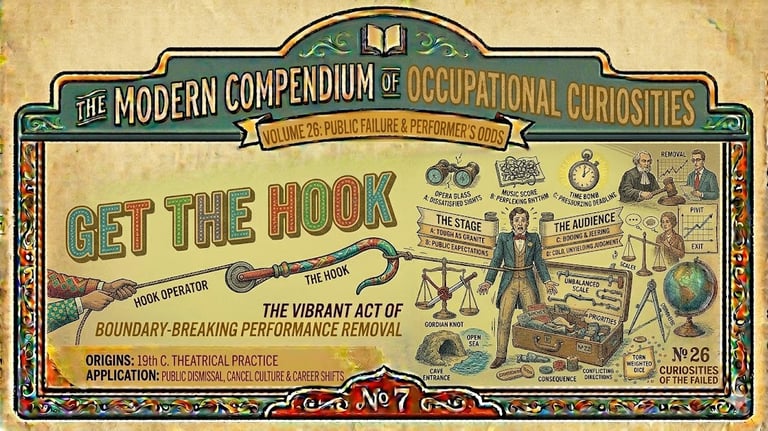
To "get the hook" means to be abruptly removed from a stage, a public position, or a project due to poor performance, incompetence, or because your allotted time has completely run out. It represents a swift, unvarnished intervention to cut short a disaster before it gets any worse.
The Deep Dive
The phrase is a literal description of a crude, crowd-pleasing theatrical device used to police bad acts during the golden age of American Vaudeville.
The Chaos of Amateur Night: In the late 19th and early 20th centuries, Vaudeville theaters across the United States regularly hosted "Amateur Nights." These events were incredibly popular, wildly chaotic, and notoriously cheap to run. Anyone from the local community could sign up to sing, juggle, recite poetry, or play an instrument. Because there was no screening process, many of the acts were spectacularly, unforgettably bad.
The Bowery Blueprint: The physical "hook" was invented in 1903 at Miner’s Bowery Theatre in New York City. The theater manager, Henry Clay Miner, faced a major problem: when an amateur act was failing, the tough, working-class Bowery audience wouldn't just boo—they would throw stale vegetables, rocks, and old shoes at the stage, endangering the performers and damaging the theater property.
The Hook Intervention: Miner devised a brilliant piece of theatrical crowd control. He constructed a massive, ten-foot-long wooden pole with a large, padded hook at the end, shaped exactly like a giant shepherd’s crook. When a performer was getting thoroughly booed off the stage, an imposing stagehand standing out of sight in the wings would slide the pole along the floor, loop the hook around the performer’s waist or neck, and violently yank them backward into the curtains.
The Entertainment Mutation: What started as a safety measure instantly became the main event. The audience loved the slapstick violence of the hook far more than they loved the good acts. Crowds would intentionally boo mediocre performers just to chant, "Get the hook! Get the hook!" * The Corporate Leap: By the 1920’s, as Vaudeville faded into radio and cinema, the phrase broke loose from the theater curtains. It entered the general lexicon as the ultimate metaphor for being fired or benched. In modern political debates or corporate presentations, saying a speaker needs to "get the hook" means their time is up and someone needs to cut the microphone before the situation derails entirely.
Fast Facts
The Apollo Tradition: The direct descendant of the Vaudeville hook lives on at the world-famous Apollo Theater in Harlem during its legendary Amateur Night. Instead of a physical hook, a tap-dancing stagehand known as "The Executioner" (most famously played by Howard "Sandman" Sims) sweeps across the stage with a broom, horn, or siren to playfully chase bad acts out of the spotlight.
The "Gong" Evolution: In the 1970’s, television producer Chuck Barris updated the Vaudeville hook for modern TV with The Gong Show. Instead of a pole pulling an actor away, celebrity judges would hit a massive, resonant physical gong to instantly stop a performance mid-sentence.
References
Slide, A. (2012). The Encyclopedia of Vaudeville. University Press of Mississippi.
Laurie, J. (1953). Vaudeville: From the Honesties to the Hoofers. Henry Holt and Co.
Oxford English Dictionary. (2026). The Lexicon of Early Twentieth-Century American Stagecraft and Institutional Dismissal Idioms.