Get Under the Skin

The Definition
This idiom carries two distinct meanings. Primarily, it refers to a persistent irritation or annoyance caused by another person’s behavior. Secondarily, it describes an emotional obsession or a deep fascination with someone or something that becomes impossible to ignore.
The Deep Dive
The phrase is a biological metaphor for intrusion, originating in the late 19th century as a literal reference to the physical discomfort of external irritants.
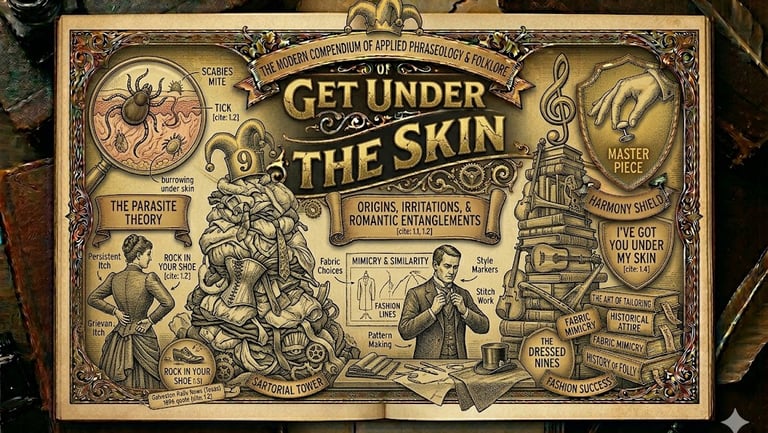
Parasitic Irritation: The earliest and most common sense of the idiom alludes to burrowing insects, parasites, or splinters that lodge themselves beneath the skin. Because these irritants are physically invasive and difficult to remove, they cause a constant, nagging discomfort. By 1896, American newspapers were already using the phrase to describe people whose words or actions lingeringly provoked a similar state of mental agitation.
The "Cole Porter" Influence: In the 20th century, the idiom took on a more complex, psychological meaning. This shift was largely popularized by the 1936 Cole Porter song, I've Got You Under My Skin. In this context, the "irritation" is transformed into an irresistible romantic obsession. It suggests that the person has bypassed one's emotional defenses and become a permanent, if sometimes painful, part of their internal thoughts.
Linguistic Versatility: Today, the phrase represents a crossover between frustration and fascination. Whether used as a complaint about a colleague’s habits or a confession of an inescapable crush, it implies that the subject has moved from a superficial encounter to a deeply personal level of influence.
Fast Facts
The "Nitty-Gritty" Connection: While both phrases involve getting past the surface, "getting under the skin" focuses on the emotional or sensory impact, whereas "nitty-gritty" focuses on the technical or practical details.
Psychological Warfare: In competitive sports, athletes often attempt to "get under the skin" of their opponents by using "trash talk" to disrupt their concentration and provoke an emotional mistake.
References
Porter, C. (1936). I've Got You Under My Skin. (Song).
Ammer, C. (2013). The Dictionary of Clichés. Skyhorse Publishing.
Oxford English Dictionary. (2026). The Biological Origins of Emotional Metaphors.