Gild the Lily
The Definition
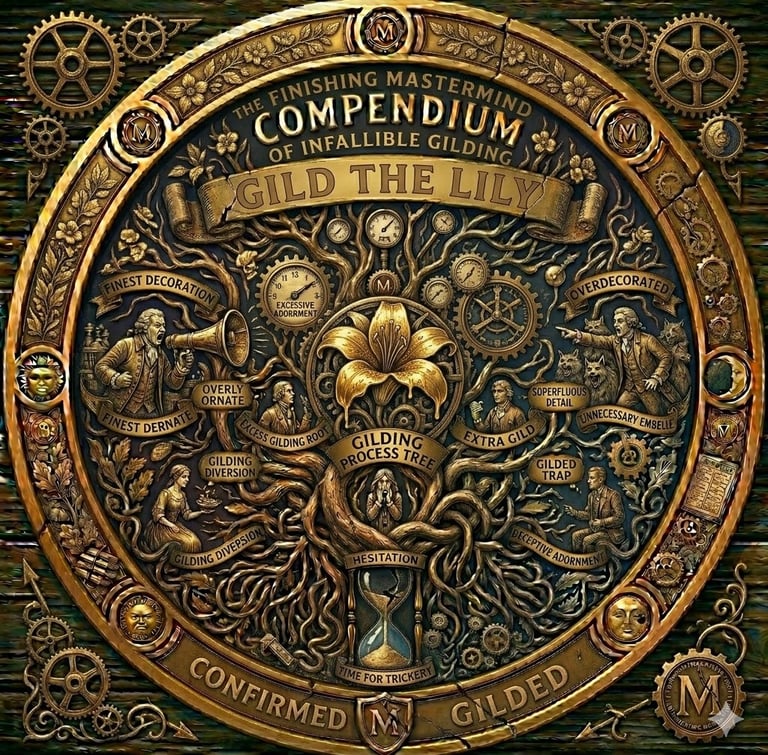
To gild the lily is to add unnecessary ornamentation to something that is already beautiful or perfect in its own right. It describes the act of over-embellishing a situation or object to the point of "wasteful and ridiculous excess," often ruining the inherent quality of the original.
The Deep Dive
The history of this idiom is a classic example of how "junk knowledge" and misquotations can evolve into a standard part of the language.
The Shakespearean Misquote: Most people attribute the phrase to William Shakespeare, but he never actually wrote the words "gild the lily." In his 1595 play King John, the character Salisbury says: "To gild refined gold, to paint the lily... is wasteful and ridiculous excess." Over the centuries, the two distinct images—gilding gold and painting a lily—were conflated by the public into the more rhythmic "gild the lily."
Metaphorical Overload: The original quote highlights the absurdity of trying to improve upon perfection. Gold is already the standard for luster, and a lily is the standard for natural purity. Attempting to add a layer of gold leaf to a flower is not an improvement; it is a clumsy interference that masks the flower's true nature.
Modern Aesthetic: Today, the phrase is frequently used in design, writing, and cooking. It serves as a reminder to the "flock" of creators that sometimes the most effective move is to stop. When a project has reached its natural peak, adding further flourishes is simply an exercise in ego that distracts from the core achievement.
Fast Facts
The "il" Factor: Linguists suggest the misquote became more popular than the original because of the pleasing alliteration of the "il" sounds in gild and lily, making it easier to remember and repeat.
The "Paint the Rose" Variant: A similar (though less common) 19th-century variation was to "paint the rose," which carried the same warning against over-embellishment in the pursuit of beauty.
References
Shakespeare, W. (1623). King John. (First Folio edition).
Ammer, C. (2013). The Dictionary of Clichés. Skyhorse Publishing.
Oxford English Dictionary. (2026). The Evolution of Literary Misquotations in Common Parlance.