Give the Axe
The Definition
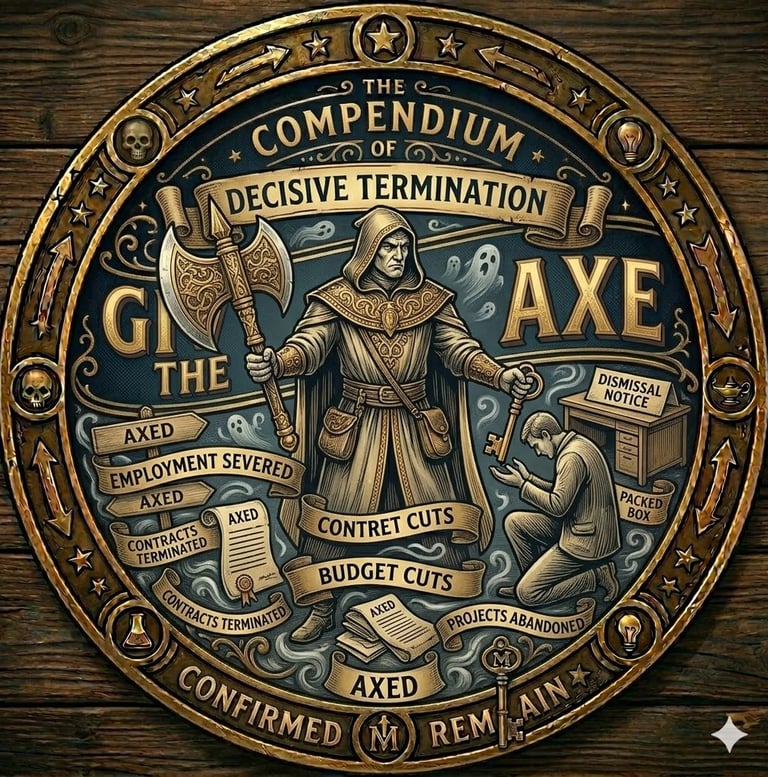
A common idiom meaning to abruptly dismiss someone from their job, or to end a relationship or project with sudden finality. It implies a sharp, decisive cut that severs a connection completely, leaving no room for negotiation or "undoing."
The Deep Dive
The "junk knowledge" behind "giving the axe" is that it is the more violent, industrial cousin of "getting the sack." While a "sack" implies you are simply packing up your tools to leave, the "axe" implies that the position itself has been beheaded.
The Executioner’s Shadow: While many assume the phrase comes from woodcutting, its darker roots lie in the history of state-sanctioned execution. In the medieval and early modern periods, "the axe" was the instrument used to end the life of a disgraced noble or official. To "give someone the axe" was the ultimate form of being "let go" from government service.
The 19th-Century Workplace: The phrase migrated into the world of labor during the Industrial Revolution. As companies grew larger and more impersonal, the "axe" became a metaphor for the budget cutter. A manager who "swung the axe" was someone who eliminated entire departments or "limbs" of a business to save the "trunk" of the company.
The Musical "Axe": Interestingly, in the world of jazz and rock, an "axe" is a term of endearment for a musical instrument (usually a saxophone or a guitar). This creates a linguistic irony: a musician might "take their axe" to a gig, only to "get the axe" from the club owner if the performance is poor.
The phrase reached peak "junk" status in the corporate "downsizing" era of the 1980's and 90's. It represents the "junk" of institutional power: the cold, mechanical reality that in a hierarchy, the "head" can always choose to "sever" the body.
Fast Facts
The "Pink Slip" Rival: While "the axe" is a verbal or structural dismissal, the "pink slip" is the physical evidence. In early 20th-century factories, a pink piece of paper was often included in a worker's pay envelope to signal their termination.
The Roman "Fasces": The ancient Roman symbol of authority, the fasces, was a bundle of rods tied around an axe. It symbolized the power of the state to both punish (the rods) and execute (the axe). This is also the root of the word "fascism."
The "Hatchet Job": While "the axe" is a clean cut, a "hatchet job" is a messy, malicious attack on someone's reputation—a "junk" version of a professional dismissal that aims to destroy the person's character rather than just their job.
References
Ammer, C. (2013). The Dictionary of Clichés. Skyhorse Publishing.
Green, J. (2010). Green’s Dictionary of Slang.
The London Museum. (2026). The History of Capital Punishment and its Linguistic Legacy.