Give the Cold Shoulder
The Definition
To intentionally ignore someone or treat them with disdain and unfriendliness. It is a social snub that signals a person is no longer welcome in a particular circle or conversation.
The Deep Dive
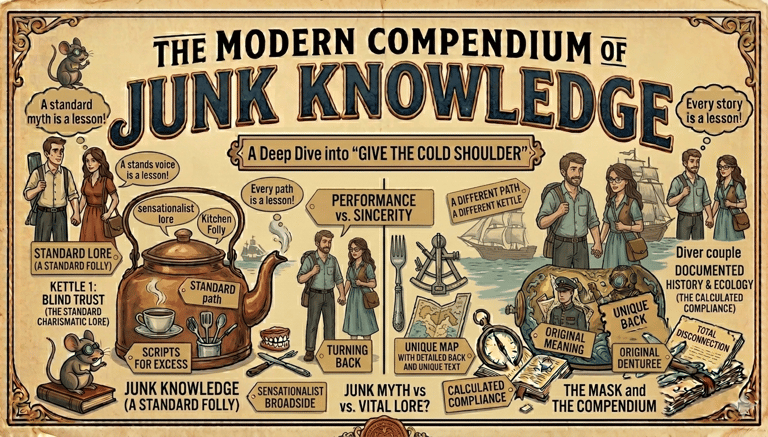
This is a "high-flavor" piece of junk knowledge that traces back to the strict rules of Medieval and Elizabethan hospitality. In an age before hotels, travelers often relied on the charity of local manors or inns.
The Warm Welcome: A guest who was highly valued or "in good standing" would be served a hot, fresh meal—usually a roasted joint of meat straight from the fire (like a "warm shoulder" of mutton or beef).
The Subtle Hint: If a guest had overstayed their welcome, or if the host wanted to signal that the relationship had soured, they wouldn't necessarily kick the person out into the night (which was considered impolite). Instead, they would serve the guest a "cold shoulder" of mutton—the leftover, fatty, unappealing scraps from a previous day's meal.
The Message: Receiving the cold shoulder was a clear, non-verbal cue: "You are no longer worth the wood for the fire. Eat your cold meat and move on."
While this "culinary snub" theory is the most popular, some linguists argue it’s a literal physical description. To "turn a shoulder" to someone is to physically rotate your body away from them, leaving them to look at your back (the "cold," unresponsive side of a human) rather than your face.
The phrase was popularized in literature by Sir Walter Scott in his 1816 novel The Antiquary, where he used it to describe a character being dismissed by his social superiors. By the mid-19th century, it had lost its association with mutton and became the universal term for the "social freeze."
Fast Facts
The "Mutton" Specificity: In 19th-century England, the shoulder was considered a "lesser" cut of meat compared to the leg or the loin. Serving it cold was the ultimate "low-tier" treatment.
The Shakespearean Absence: Despite sounding like a Shakespearean insult, the Bard never actually used the phrase; it took another two centuries to become a common idiom.
The "Backhanded" Compliment: This is a linguistic cousin to the "left-handed compliment" or "damning with faint praise"—ways of being rude while maintaining a thin veneer of politeness.
References
Scott, W. (1816). The Antiquary. (Archibald Constable and Co.).
Ammer, C. (2013). The Dictionary of Clichés. Skyhorse Publishing.
Tannahill, R. (1973). Food in History. Stein and Day.
The Oxford English Dictionary. (2026). Shoulder (n.). Oxford University Press.