Give the Runaround
The Definition
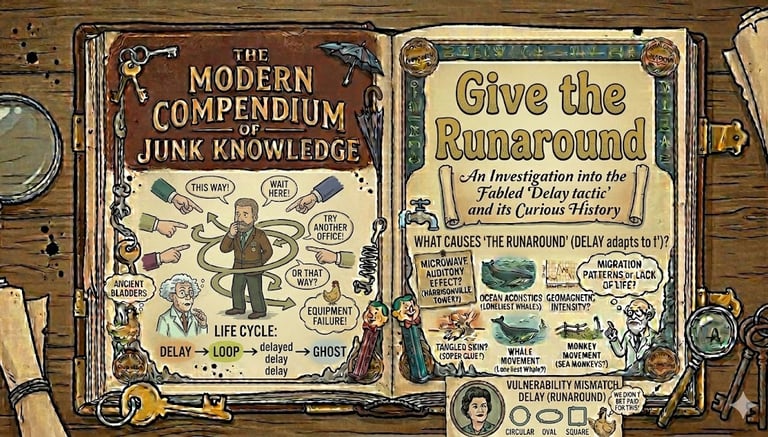
This idiom refers to the act of providing evasive, diversionary, or intentionally unhelpful responses to a person’s inquiries. It typically involves directing an individual to multiple different sources or departments to avoid taking responsibility or providing a direct answer, resulting in a state of perpetual "junk" movement without progress.
The Deep Dive
The phrase is a behavioral metaphor that emerged in the late 19th and early 20th centuries, likely reflecting the increasing complexity of modern bureaucracy and social etiquette.
Bureaucratic Evasion: The core of the idiom is the concept of a circular path. In a large organization, a person seeking information might be told by Department A that they must speak to Department B, only for Department B to send them back to Department A. This "runaround" ensures that the individual remains in motion but never reaches their destination. It is the antithesis of a direct path, designed to exhaust the seeker until they abandon their quest.
The "Social" Runaround: In interpersonal relationships, the phrase was historically used to describe a person who avoids making a firm commitment to a date or a proposal. Instead of a "straight arrow" rejection, the individual offers vague excuses or shifts the topic, effectively keeping the other person at a distance while remaining technically polite.
Linguistic Evolution: The term gained significant traction in the 1930's and 40's as public frustration with government and corporate "red tape" increased. It represents a situation where the "flock" of administrators uses complexity as a shield against accountability, forcing the individual into a repetitive and fruitless cycle of effort.
Fast Facts
The "Red Tape" Connection: While "the runaround" describes the action of being diverted, "red tape" refers to the rules and regulations that allow such diversions to occur.
Musical Influence: The phrase was cemented in modern pop culture through various blues and rock songs throughout the 20th century, typically depicting a protagonist frustrated by a lover’s evasive behavior.
References
Ammer, C. (2013). The Dictionary of Clichés. Skyhorse Publishing.
Lighter, J. E. (1994). Historical Dictionary of American Slang.
Oxford English Dictionary. (2026). The Sociology of Institutional Evasion in the 20th Century.