Go Against the Grain
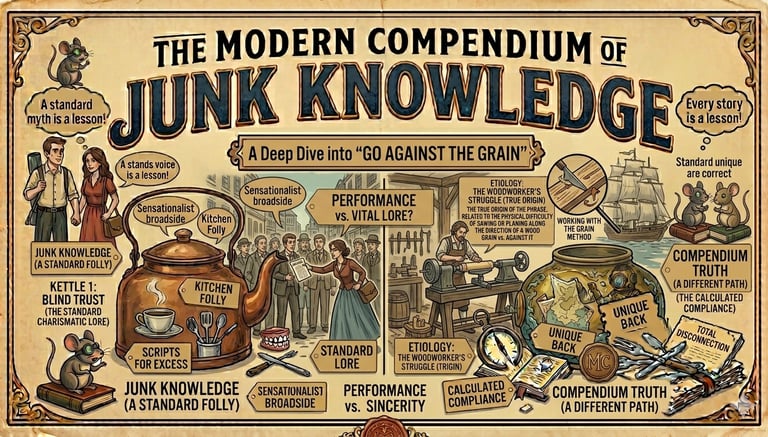
The Definition
To act in a way that is contrary to one's natural inclinations, or to oppose the prevailing standard or trend. It describes a task or a choice that feels fundamentally difficult because it defies the "natural flow" of the situation.
The Deep Dive
This is a "high-friction" piece of junk knowledge from the literal, physical labor of pre-industrial woodworking. Before the invention of power sanders and synthetic composites, every builder had to be a master of "reading" the wood.
The Biology of the Tree: "Grain" refers to the longitudinal arrangement of wood fibers. These fibers grow vertically to transport water and nutrients. In a finished plank, these fibers all point in a dominant direction.
The "With" vs. "Against": * With the Grain: If you run a plane or a saw "with" the grain, the blade slices cleanly through the fibers, leaving a smooth, polished surface. It is the path of least resistance.
Against the Grain: If you push your tool "against" the grain, the blade catches on the ends of the fibers, tearing them upward. Instead of a smooth cut, you get "chatter," splinters, and a jagged, ruined surface. It requires significantly more physical strength and produces a much poorer result.
The "Shakespeare" Shift: While woodworkers have known this since the Bronze Age, the metaphor was polished by William Shakespeare. In his 1607 play Coriolanus, he used the phrase to describe a character's stubborn nature: "Preach’d to 'em, if they did budge, against the grain."
The phrase moved from the carpenter’s bench to the general lexicon by the late 17th century. It became a favorite of the Enlightenment thinkers to describe anyone who challenged the status quo or "rubbed" the establishment the wrong way by refusing to follow the easy, "natural" path of society.
Fast Facts
The "Rub the Wrong Way" Link: This is a direct linguistic sibling. While "rubbing" refers to the irritation caused to others, "going against the grain" refers to the internal resistance felt by the person doing the work.
The "End Grain" Exception: In woodworking, the "end grain" (the cut cross-section of the tree) is the most difficult to work with, leading to the 19th-century slang "tough as end-grain" for a stubborn person.
The First Print: Beyond Shakespeare, the phrase became a staple of English dictionaries by the 1670's, specifically categorized under "mechanical metaphors."
References
Shakespeare, W. (1607). Coriolanus. (Act II, Scene 3).
Moxon, J. (1678). Mechanick Exercises: Or the Doctrine of Handy-Works.
Ammer, C. (2013). The Dictionary of Clichés. Skyhorse Publishing.
The Oxford English Dictionary. (2026). Grain (n.1). Oxford University Press.