Go Fly a Kite
The Definition
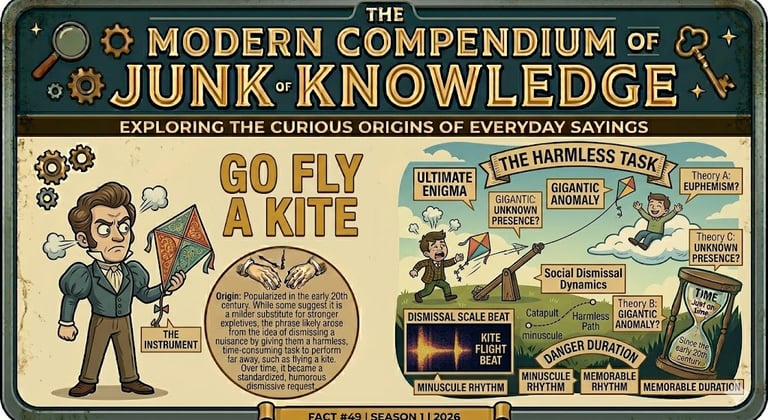
"Go fly a kite" is a dismissive idiom used to tell someone to go away or to stop bothering you. It is a polite—or at least socially acceptable—way of expressing annoyance, suggesting that the person should find a useless, solitary activity to occupy themselves elsewhere.
The Deep Dive
This phrase is a product of the mid-20th century, emerging as part of a wave of colorful American slang used to brush off unwanted attention.
The Solitary Distraction: Unlike many idioms that have roots in medieval trade or ancient warfare, "go fly a kite" relies on the literal nature of the activity. Kite flying requires a significant amount of distance from others (to avoid tangling lines) and total focus on a distant object. By telling someone to do it, you are effectively telling them to move to an open field far away and look in the opposite direction.
The 1940's Peak: The phrase gained massive traction in the 1940's and 50's. It was often used in film noir and hardboiled detective novels as a snappy retort. It belonged to a family of "go away" phrases that included "take a long walk on a short pier" and "go chase yourself."
The "Junk" Utility: In the hierarchy of insults, "go fly a kite" is relatively mild. It lacks the aggression of modern profanity, instead favoring a tone of weary exasperation. It implies that the person's current behavior is so "junk" or trivial that they might as well be doing something as inconsequential as playing with a string in the wind.
Fast Facts
The Peanuts Connection: The phrase saw a resurgence in popular culture through the Peanuts comic strip, where Charlie Brown—the perpetual "black sheep" of the neighborhood—was frequently told to "go fly a kite" by Lucy van Pelt.
International Variations: In some cultures, the equivalent phrase is "go fry an egg" (Italian: va' a farti friggere) or "go count the waves."
References
Ammer, C. (2013). The Dictionary of Clichés. Skyhorse Publishing.
Lighter, J. E. (1994). Historical Dictionary of American Slang.
Oxford English Dictionary. (2026). The Rise of Dismissive Colloquialisms in Mid-Century America.