Go Haywire
The Definition
To break down, malfunction, or become uncontrollably chaotic. It describes a situation where a system (mechanical or social) has lost its internal logic and is now behaving in a wild, unpredictable, and potentially dangerous manner.
The Deep Dive
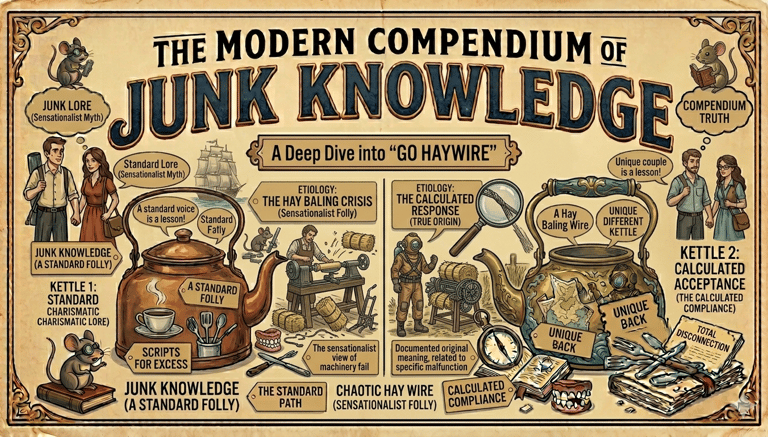
This is a literal piece of "junk knowledge" from the late 19th-century American farm. Before the invention of the automated combine or modern synthetic netting, farmers relied on baling wire—a thin, high-tensile strength steel wire—to bind together massive bundles of hay and straw.
The Tension: Baling wire was shipped in tightly wound, pressurized coils. Because it was made of springy steel, it held a tremendous amount of kinetic energy.
The "Snap": If the wire was cut improperly, or if the baling machine malfunctioned, the coil would suddenly "let go." The wire would whip out in every direction with incredible speed, twisting into impossible, jagged tangles that were nearly impossible to straighten.
The Danger: A "haywire" situation wasn't just messy; it was hazardous. A snapping wire could easily slice through clothing or skin, and once a pile of hay became "haywire," it was a chaotic trap for both farmers and livestock.
The phrase moved from the barnyard to the factory floor during the 1920's. It was used by loggers and mechanics to describe machinery that had been repaired with "haywire" (a temporary, flimsy fix) and eventually came to mean the total, erratic collapse of any organized system.
Fast Facts
The "Haywire Outfit": In the early 20th century, a "haywire outfit" was a derogatory term for a logging camp or construction crew that used cheap, makeshift repairs instead of proper equipment.
The Electronic Link: In the 1950's, the term was adopted by early computer scientists to describe "spaghetti code" or poorly organized wiring that led to unpredictable system crashes.
The First Print: While the physical act of wire tangling is older, the idiom "to go haywire" first appeared in American newspapers around 1905, specifically referring to broken-down farm equipment.
References
Flexner, S. B. (1982). Listening to America. Simon & Schuster.
Ammer, C. (2013). The Dictionary of Clichés. Skyhorse Publishing.
The Oxford English Dictionary. (2026). Haywire (n. and adj.). Oxford University Press.
The Journal of Agriculture. (1898). Notes on the Proper Handling of Baling Wire.