Go Overboard
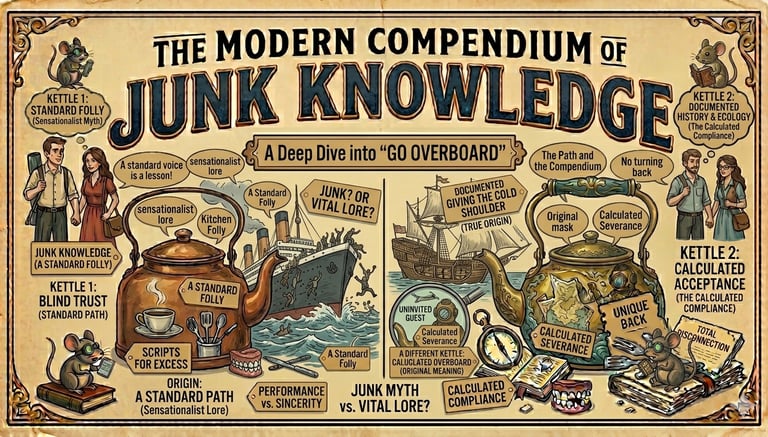
The Definition
To do something to excess; to show too much enthusiasm or over-react to a situation. It describes a person who has lost their sense of proportion and has "fallen" into an extreme position.
The Deep Dive
This is a literal piece of "junk knowledge" from the high-stakes world of 18th-century naval warfare. While we now use it to describe someone who spent too much on a birthday party, the origin is a life-or-death mechanical failure of a warship.
In the Age of Sail, the "firepower" of a ship-of-the-line was determined by its heavy bronze or iron cannons. These guns were mounted on wooden carriages and held in place by a complex system of thick hemp "breeching ropes."
The Recoil: When a cannon was fired, the explosive force sent the several-ton gun hurtling backward. The ropes were designed to catch the gun and stop it before it smashed through the opposite side of the ship.
The "Overboard" Disaster: If a ship was rolling heavily in a storm, or if a gun was fired during a sharp turn, the momentum could snap the ropes. A "loose cannon" (another famous idiom) would then roll wildly across the deck. In the worst-case scenario, the weight and momentum would carry the gun—and often the sailors trying to restrain it—right through the gunport or over the low railing.
The Result: To "go overboard" meant to lose a vital, expensive piece of equipment (and potentially a crew member) to the sea due to a lack of control or excessive force.
The phrase moved from the literal "falling into the water" to the metaphorical "excessive behavior" in the mid-1800's. It was popularized in Victorian literature to describe someone who had "plunged" too deeply into a new fad, a political movement, or an emotional outburst.
Fast Facts
The "Deep End" Cousin: This is a linguistic relative to "jumping off the deep end," though the nautical version implies a lack of intention—you didn't jump; the momentum of your own actions carried you over the side.
The First Print: The literal use dates back to the 1600's, but the figurative sense ("he went overboard on the decorations") began appearing in American English around the 1870's.
The "Man Overboard" Protocol: In actual sailing, "Man Overboard" is one of the most serious emergencies a crew can face, requiring an immediate "heave-to" maneuver to stop the ship’s forward progress.
References
Falconer, W. (1769). A Universal Dictionary of the Marine.
Jeans, P. D. (2004). Ship to Shore: A Dictionary of Pictorial Maritime Grammar. McGraw-Hill.
Ammer, C. (2013). The Dictionary of Clichés. Skyhorse Publishing.
The Oxford English Dictionary. (2026). Overboard (adv.). Oxford University Press.